
Turn the heating off and let it cool, open the filling loop valves slowly until the gauge reads 1 to 1.5 bar, then close both valves firmly. That is the whole job. But note how often you do it: Worcester Bosch says once or twice a year is normal, and anything more frequent means water is escaping somewhere.
How to Repressurise a Boiler (and When You Shouldn’t)
Repressurising a boiler is a five-minute job that manufacturers design for homeowners to do themselves. No tools, no Gas Safe engineer, no drama. If your gauge has slipped below 1 bar and the heating has locked out, the steps below will have it running again before the kettle boils.
But there are two halves to this article, and the second matters more. Knowing how to repressurise a boiler is useful. Knowing when you should stop repressurising it and ask why, that is the part that saves floors, ceilings and four-figure repair bills. We attend homes where someone has been topping up weekly for a year, and the water they kept adding is in the building.
What this guide covers
The pressure you are aiming for
With the system cold, the gauge should read between 1 and 1.5 bar, which is the range Worcester Bosch specifies and most other manufacturers echo. Below 0.5 bar, water has been lost and the boiler will usually lock out. The needle climbing while the heating runs is normal thermal expansion; around 2.75 bar or more is too high and into the red zone.
Check your own manual for the exact figure if you have it, because models vary slightly. Aim for the middle of the green band and you will not go far wrong.
Find your filling loop
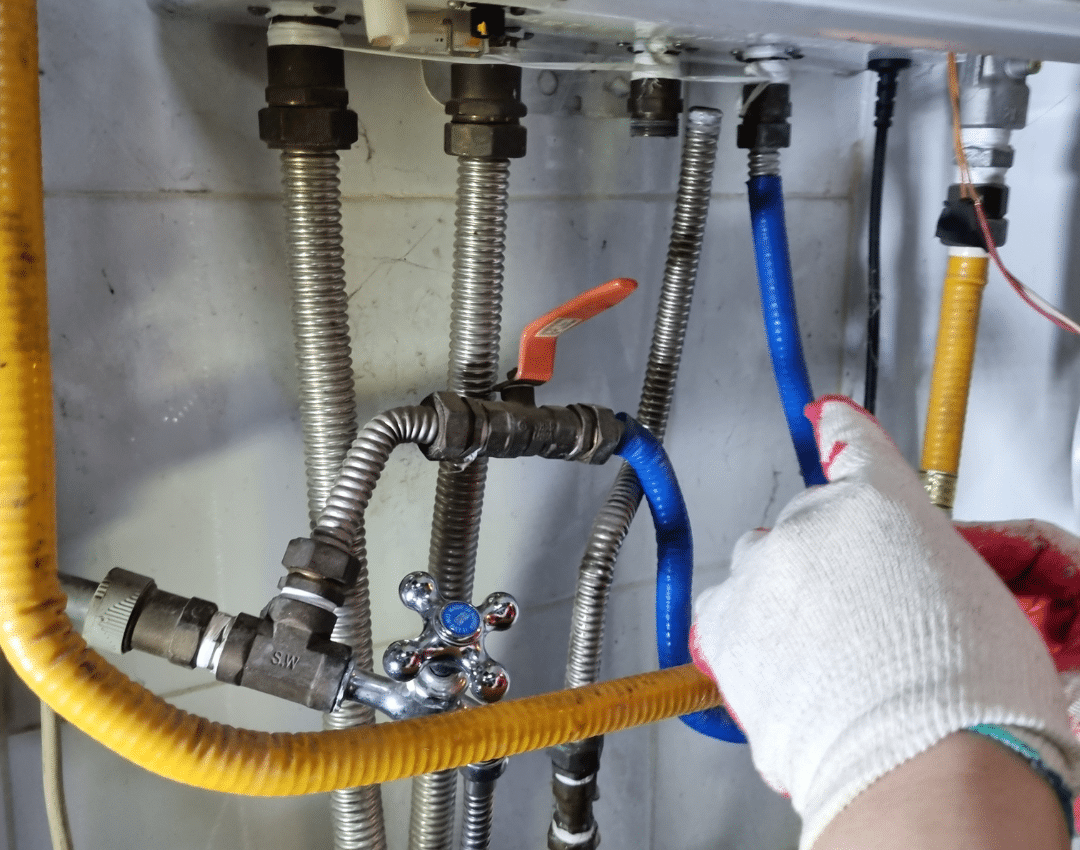
The filling loop is the bridge that lets mains water into the sealed heating circuit, and it lives among the pipework underneath the boiler. It takes one of three common forms.
The classic external loop is a short silver braided hose linking two pipes, with a small valve at each end (lever handles or screw heads). Some installations keep the hose detached as a deliberate reminder that the loop should not stay connected.
Newer boilers often have a built-in filling key or filling lever instead, in which case the boiler manual shows the exact routine. The principle is identical: open, watch the gauge, close.
Take a photo of yours before you touch anything. If a valve sticks or a handle position confuses you later, the photo shows you exactly how it started.
How to repressurise a boiler, step by step
Step 1: Switch off and cool down
Turn the boiler off and let the system cool for a while. You want a true cold reading, because pressure rises with temperature and topping up a hot system leaves it overfilled once it cools.
Step 2: Check the gauge
Note the cold reading. Below 1 bar and it needs water. Photograph it; the habit pays off later.
Step 3: Open the filling loop slowly
Open the first valve fully, then ease the second one open gently. You will hear water rushing into the system. Keep your eyes on the gauge, not the valves; the needle moves faster than you expect.
Step 4: Stop at 1 to 1.5 bar
Close the second valve as the needle reaches the target, then close the first. Aim for the middle of the green band rather than the top of it, since the pressure will rise when the heating runs.
Step 5: Close both valves firmly and restart
Check both valves are fully shut (a loop left cracked open causes slowly rising pressure and a dripping relief valve outside). Switch the boiler back on, reset the fault code if it shows one, and confirm the gauge holds.
If it will not hold, or you overshoot
Overshot to 2 bar or more? Bleed a radiator briefly to let water out until the gauge returns to the green band; that is the accepted fix rather than anything at the boiler itself. Keep a cloth around the bleed key because the escaping water can be grubby.
If the pressure falls again within hours or days of topping up, or the boiler locks out repeatedly, stop and reread the situation. Fast loss usually means the pressure relief valve is passing, the expansion vessel has failed, or the system is leaking. A Gas Safe engineer handles the first two. The third is our department, and it brings us to the half of this article that matters most.
When you should not just top up
A sealed heating system should need topping up once or twice a year, and Worcester Bosch’s own guidance says that if you are repressurising much more often, you should get the system looked at. Read that as a threshold. Top-ups every few weeks are not a quirk of your boiler. They are a measurement of water escaping into your home.
Here is the trap with routine top-ups: they make the symptom disappear. The heating works again, the fault code clears, and life moves on. Meanwhile the same water you added leaks back out, somewhere under a floor or inside a wall, week after week. By the time a stain or smell finally surfaces, the damage has been accumulating for months. The gauge was telling the truth the whole time; the top-ups just kept resetting the evidence. Our article on why boilers lose pressure ranks the likely causes, and the overnight pattern gets a deep dive in boiler pressure dropping overnight.
Repeated top-ups also poison the system slowly. Every refill drags in fresh oxygenated mains water, which feeds corrosion inside the pipework and dilutes the inhibitor chemicals protecting your radiators. Frequent topping up literally shortens the life of the system it appears to be helping.
If you are topping up more than once a season, call us on 07700 152 467. Describing the pattern over the phone costs nothing, and it usually tells us whether you need a plumber, a Gas Safe engineer or a leak survey.
Keep a pressure diary
Two minutes a day, one week, real answers
- Photograph the gauge cold every morning; the timestamp builds the record for you
- Note each evening whether the heating ran that day
- Record every top-up with date and the pressure before and after
- Check the relief valve discharge pipe outside for drips at the same time
- After a week, look at the shape: loss only on heating days, steady loss, or overnight drops
That one-week record transforms the conversation with any engineer. Steady loss whether or not the heating runs points to a constant escape. Loss concentrated overnight, as the system cools and contracts, is a classic signature of a small hidden leak. Loss only under heat suggests joints or valves that weep when hot. Each pattern sends the investigation somewhere different, which is why the diary saves you money before anyone arrives.
What the escaping water is doing while you top up
Think about where heating pipes actually run: under suspended timber floors, buried in screed, chased into walls, threaded behind kitchen units. A pinhole leak on any of those runs releases warm water into the building fabric continuously. It rarely puddles. It soaks joist ends, swells chipboard, lifts flooring adhesives and feeds mould, all invisibly, and in an unmetered Scottish home there is no water bill spike to give the game away either.
The pressure gauge is often the only witness. Treat persistent pressure loss with the same seriousness as a visible drip, because it is one, just somewhere you cannot see. Finding it does not mean lifting floors on spec any more: system isolation narrows the leak to one circuit, thermal imaging follows the warm pipe runs, and tracer gas pinpoints splits under solid floors. One marked spot, one small opening, job done. Our guide to finding a leak in a central heating system walks through the whole process.
Frequently asked questions
What pressure should I repressurise my boiler to?
Between 1 and 1.5 bar with the system cold, per Worcester Bosch guidance, and most manufacturers agree. Aim for the middle of the green band, because pressure rises as the system heats. Your boiler manual gives the exact figure for your model if you want to be precise.
Do I need an engineer to repressurise a boiler?
No. Topping up via the filling loop is a routine homeowner task and needs no Gas Safe qualification, because you are not opening the boiler casing or touching gas. Where you do need an engineer is when top-ups become frequent, valves will not close, or the relief valve keeps discharging.
How often should a boiler need repressurising?
Once or twice a year is normal, according to Worcester Bosch. A system that needs monthly or weekly top-ups is losing water abnormally, through a faulty component or a leak on the pipework. The frequency of your top-ups is the single most useful number you can give any engineer.
Why does my boiler lose pressure again straight after repressurising?
Rapid loss within hours points to water escaping fast: a passing pressure relief valve, a failed expansion vessel or a live leak. Check the discharge pipe outside for dripping first. If it is dry and the gauge still falls, the water is going into the building, and the leak needs locating.
Is it bad to keep topping up a boiler that keeps losing pressure?
Yes, on two counts. The escaped water is soaking into floors and walls somewhere, and every refill adds fresh oxygenated water that corrodes the system from inside while diluting its inhibitor. Topping up is first aid, not treatment. If it has become routine, the cause needs finding.
Related reading
- Boiler Losing Pressure? Causes and What to Do Next
- Boiler Pressure Dropping Overnight: What It Usually Means
- How to Find a Leak in a Central Heating System
MCR Leak Detection provides water leak detection across Scotland, specialising in hidden central heating leaks.
Speak to MCR Leak Detection
If topping up has become a habit, the leak is already in your home. We locate central heating leaks non-destructively across Scotland, 24/7, so the repair happens once, in exactly the right place.