
A leak detection report is the independent evidence behind a water leak claim. It records where the leak was, how it was found, the moisture damage measured and why access was needed. Insurers use it to approve trace and access costs and settle claims faster, and businesses need one for a Burst Allowance.
Why Insurers Ask for a Leak Detection Report (and What’s in One)
Somewhere between the leak being fixed and the claim being paid, most insurers ask the same question: can you show us a report? It catches people out. You have the soggy carpet, the plumber’s invoice and the photos, and now the insurer wants a document you have never heard of.
A leak detection report for insurance is not bureaucratic padding. It is the piece of evidence that answers, in one place, the questions every claim turns on: where the leak was, what it damaged, when it was found and whether the costs claimed were justified. This guide explains what a proper report contains, how it moves a claim along, and what to check before you commission one.
What’s in this guide
Why insurers ask for a leak detection report at all
An insurer processing an escape of water claim has three concerns. Was this a sudden event the policy covers, rather than gradual damage it excludes? Are the trace and access costs genuine and proportionate? And is the damage being claimed actually connected to this leak?
Your word answers none of those to an adjuster’s satisfaction, and a plumber’s invoice saying “repaired leak” barely helps. An independent detection report answers all three. It documents a specific fault at a specific location, found on a specific date with recognised methods, along with the moisture readings that map exactly how far the damage spread. That is why requests for reports have become routine, particularly where trace and access cover is being used.
What a professional report actually contains
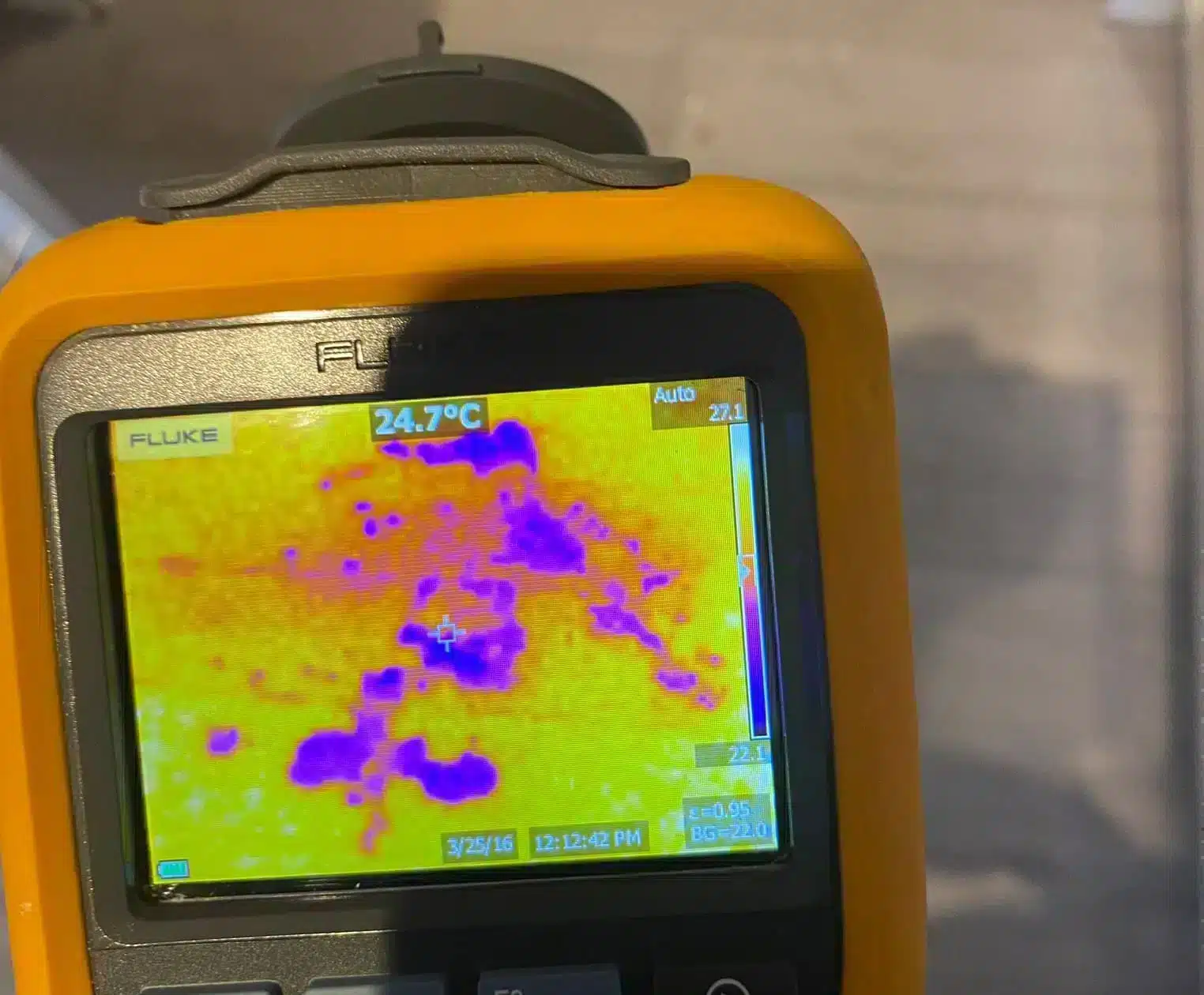
Reports vary between firms, but a survey report worth its fee covers:
- Property and instruction detailsWho commissioned the survey, the address, the date attended and the problem reported.
- Methods usedWhich techniques were deployed, thermal imaging, acoustic listening, tracer gas, moisture mapping, and where each was applied.
- Findings with evidenceThermal images, photographs and moisture meter readings, room by room, showing the extent of dampness.
- The pinpointed leak locationExactly where the fault is, on which pipe or fitting, and the suspected cause.
- Access and repair guidanceWhat needs opened to reach the leak, and recommendations for repair and drying.
The moisture readings deserve a special mention. They record the damage as it stood on the survey date, which becomes the baseline for drying and reinstatement. If a dispute arises later about how far the damage extended, the numbers are already on paper. Our guide to moisture meter readings explains what those figures mean.
The trace and access connection
Trace and access cover pays for locating a hidden leak and making good the access, and it is where a detection survey usually sits within a claim. MoneySuperMarket, citing Defaqto, reports that 94% of buildings policies include the cover, with limits typically between £5,000 and £10,000.
The report is what connects the survey cost to the cover. It shows the insurer that locating the leak required professional equipment, that the access opened was the minimum necessary, and that the invoice matches work actually done. Without it, you are asking the insurer to fund a search they cannot see. With it, the claim under that section is usually straightforward.
There is a practical bonus too. A pinpointed leak means one small access hole rather than a trail of exploratory ones, which keeps you comfortably inside the policy limit and keeps your home intact.
How a report speeds up the claim
Claims stall on unanswered questions. Every question an adjuster has to investigate adds days or weeks, and every gap in the evidence invites a lower offer. A detection report closes the gaps early.
- It dates the discoveryThe report proves when the leak was found and investigated, which matters enormously if anyone raises the gradual damage exclusion. Prompt professional investigation is hard to paint as neglect. Our guide to slow leaks and insurance explains why this timeline is worth protecting.
- It separates cause from damageThe insurer can see which costs belong to trace and access, which to reinstatement, and which, like the pipe repair itself, sit outside the policy. Fewer grey areas, fewer arguments.
- It gives the adjuster something to agree withAdjusters move faster when an independent professional has already documented the loss. The scope discussion starts from the report’s findings rather than from scratch.
Mid-claim and being asked for a report you do not have? Call us on 07700 152 467. We survey, locate and produce insurer-ready documentation, often within days.
Businesses: the report that unlocks a Burst Allowance
For Scottish businesses the report earns its keep twice. Business premises are metered, so a leak shows up as a swollen water bill, and relief exists: Scottish Water’s Burst Allowance policy, claimed through your Licensed Provider such as Business Stream, allows up to 9 months’ allowance for biannually read meters and a 50% water-and-waste allowance for private leakage.
The evidence requirements are specific: the repair date, the estimated start of the leak, a plumber’s or leak detection report, and two meter readings taken a week apart after the repair. A detection report that documents the fault and the repair evidence sits at the centre of that application. Commercial premises with long pipe runs are exactly where leaks hide longest, something we cover in our commercial leak detection guide.
What to check before commissioning a report
Ask these before booking a survey
- Is a written report included in the price, or an extra? Get this confirmed up front
- Which detection methods do they carry? A firm with one tool finds one kind of leak
- Does the report include thermal images, photographs and moisture readings, not just a summary?
- Have they produced reports for insurance claims before, and will the format satisfy an adjuster?
- How quickly after the visit does the report arrive? A claim waits on it
On cost, detection surveys are a market with real variation, and it pays to understand the ranges before you book. Our leak detection cost guide sets out what named UK sources report, and any decent firm will quote clearly before attending.
Frequently asked questions
Is a leak detection report required for every water leak claim?
No. If the leak was visible and obvious, photos and a plumber’s invoice often suffice. Reports matter when the leak was hidden, when trace and access costs are being claimed, or when the insurer questions the cause or extent of damage. Many insurers now request one as standard on larger claims.
Who pays for the leak detection report?
Where the policy includes trace and access cover, the survey and report are normally claimable under that section, subject to your limit and excess. MoneySuperMarket, citing Defaqto, reports 94% of buildings policies include the cover. Confirm with your insurer before booking if you want certainty.
Can my plumber just write the report instead?
A plumber’s invoice confirms a repair happened, but it rarely documents how the leak was located, the moisture spread or why access was justified. For hidden leaks, insurers give more weight to a survey using recognised detection methods with recorded evidence. For simple visible failures, a plumber’s account may be enough.
How long does it take to get a report after the survey?
Ask when booking, because practice varies. The survey itself usually takes a few hours, and a written report typically follows within a few working days. If your claim is time-sensitive, say so up front; the leak location can often be shared with your plumber on the day, ahead of the paperwork.
Does a report guarantee my claim will be paid?
No document can promise that; the policy wording decides. What a report does is remove the evidence gaps claims fail on: it proves the leak existed, dates its discovery, maps the damage and justifies the access costs. Claims supported that way settle faster and are far harder to dispute.
Speak to MCR Leak Detection
Need a leak found and documented properly? We locate hidden leaks non-destructively across Scotland, 24/7, and deliver a clear written report your insurer, adjuster or Licensed Provider can act on.
Related reading
- What Is Trace and Access Cover? Home Insurance Explained
- How to Make a Water Leak Insurance Claim (Step by Step)
- Does Home Insurance Cover Water Leaks? Escape of Water Explained
- How Much Does Leak Detection Cost? UK and Scotland Price Guide
Or learn more about our water leak detection across Scotland.