

DIY leak detection is good at proving whether a leak exists: visual checks, a stop valve test, a boiler pressure diary and a toilet dye test cost nothing and are safe. It is poor at finding where a hidden leak is. Once the pipe is under a floor, in a wall or underground, guessing gets expensive and a professional survey pays for itself.
DIY Leak Detection vs Calling a Professional: An Honest Guide
A leak detection company telling you what you can do yourself might seem odd. But we would rather you tried the free checks first. DIY leak detection answers one question well: is there a leak at all? Done properly, it can also tell you which system is losing water. What it cannot reliably do is tell you where a hidden pipe is leaking, and that is where wrong guesses start costing real money.
Here is where the line sits, drawn honestly from both sides of it.
What this guide covers
What you can genuinely check yourself
These checks are free, safe and worth an hour of anyone’s time. They are the same first steps we run through on the phone with callers, and several have full walkthroughs on this site, starting with our pillar guide on how to find a water leak.
- A visual auditLook under sinks, behind the washing machine, around the toilet base, inside the boiler cupboard and along visible pipe runs. Feel for dampness rather than trusting your eyes; slow weeps hide behind flexi hose braiding and compression nuts.
- The stop valve testTurn off the stop valve inside your home. If you can still hear water moving, or a fitting keeps hissing, water is going somewhere it should not.
- A boiler pressure diaryNote the gauge reading morning and night for a week. A steady downward drift with no radiator bleeding points to a heating circuit leak. Our guide to a boiler losing pressure ranks the likely causes.
- The toilet dye testA few drops of food colouring in the cistern. Colour in the bowl an hour later without flushing means the flush valve is passing water constantly.
- Listen at nightWith the house silent, put your ear to pipework near the stopcock. A faint continuous hiss with every outlet off is a classic hidden leak signal.
The Scottish twist: no meter to help you
Most DIY advice online is written for England, where the standard test is reading the water meter with everything switched off. That advice fails here. Most Scottish households have no water meter, because charges are collected through council tax, as Scottish Water explains. There is no dial to prove a leak, and no water bill spike to warn you either.
That cuts both ways. A leak in an unmetered Scottish home costs nothing on the bill, so it announces itself through damage instead: damp, staining, mould, a rotting joist. The checks above matter more here, not less, and we cover the meterless versions in how to check for a leak without a meter.
Where DIY leak detection stops
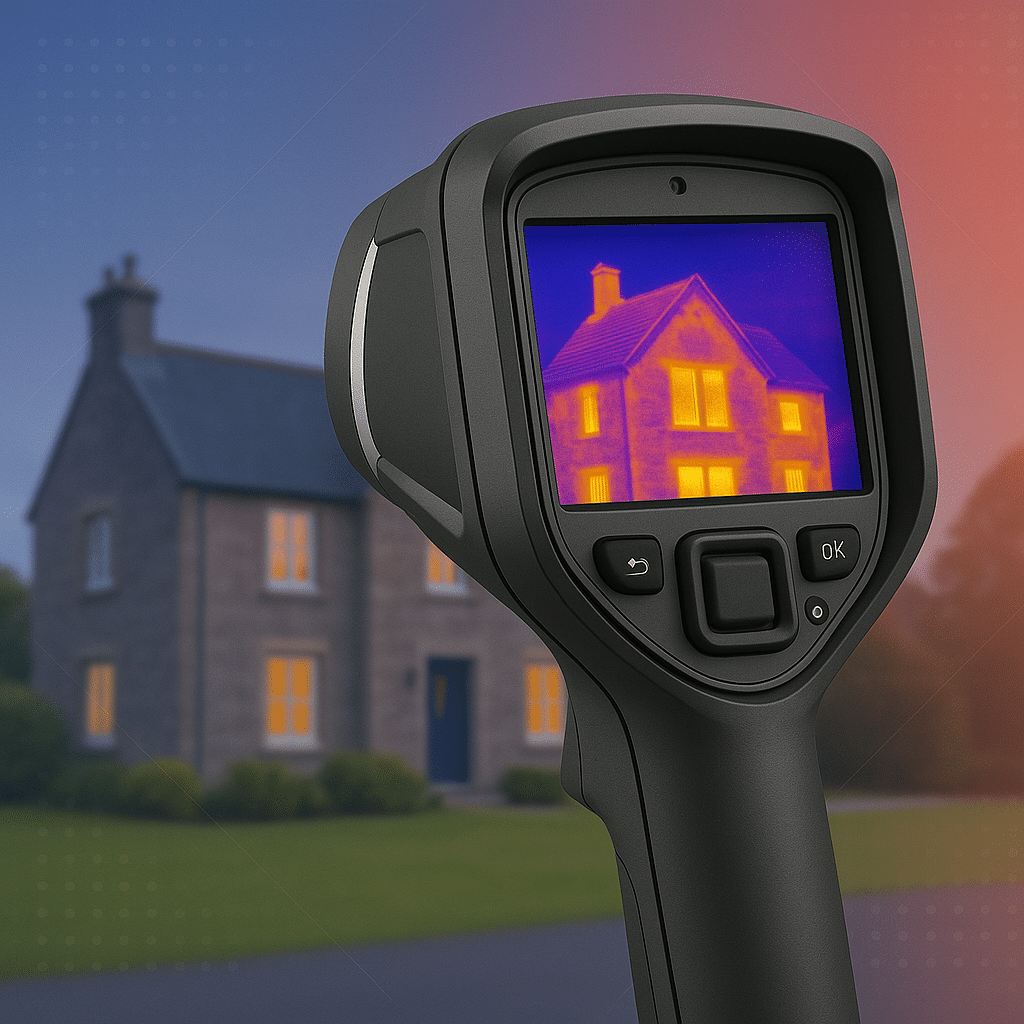
The line is location. Your checks can prove the heating circuit is losing water. They cannot tell you which of forty metres of buried pipe has the hole. The moment the suspect pipe is under a solid floor, inside a wall, beneath a driveway or in an underfloor heating loop, DIY has done its job and the next step is instrumentation: acoustic microphones, thermal cameras, tracer gas and moisture mapping.
Cheap DIY versions of these tools exist, and they mislead more than they help. A £30 moisture meter will happily read high on a wall that has condensation, old staining or salts, and a phone thermal camera shows warm patches with a dozen innocent causes. The instrument is not the skill; the interpretation is.
The real cost of a wrong guess
The expensive mistake is not paying for detection. It is opening the building in the wrong place. Lifted laminate rarely goes back down well. A broken-out strip of concrete floor, with the pipe found dry underneath, still has to be reinstated. Against that, the market prices for getting it located properly look like this:
Sources: Checkatrade’s 2026 cost guide, ADI Leak Detection, Ideal Response and MoneySuperMarket. And that last figure matters: if the leak is damaging your home, most buildings policies will pay the locating cost under trace and access cover, which changes the DIY-or-professional sums entirely. Our price guide explains what moves the number, and we will always give you a quote before any work.
DIY checks vs a professional survey
DIY checks are right when
- You want to confirm a leak exists before spending anything
- The leak is visible or reachable, like a weeping trap or flexi hose
- You need evidence for a landlord, factor or insurer that something is wrong
- You are narrowing down which system loses water
DIY stops being right when
- The pipe is under a floor, in a wall or underground
- Opening up would mean damaging finishes you care about
- An insurance claim needs a proper detection report
- Repeated guesses have already found nothing
A simple decision checklist
Call a professional if any of these apply
- The stop valve test or pressure diary confirms a leak, but nothing visible explains it
- The suspect pipework runs under a solid floor, a driveway or inside a finished wall
- Boiler pressure keeps dropping after every repressurise
- A ceiling stain keeps returning after drying out
- You are about to lift flooring or chase plaster on a hunch
- An insurer, landlord or factor needs formal evidence of the leak location
Sitting on the fence with a floorboard half up? Call us on 07700 152 467 before you lift the rest, and we will tell you honestly whether a survey is worth it for your situation.
What a professional visit adds
Three things, mainly. First, equipment that answers questions DIY cannot: which exact point on a buried run is leaking. Second, interpretation, because every instrument gives false positives to an untrained eye. Third, a written report with the location, method and findings, which is what insurers expect when a claim involves hidden pipework. We explain what goes into one in why insurers ask for a leak detection report.
The honest summary: do the free checks, trust what they prove, and stop before the crowbar comes out. Finding the leak is a measuring job, not a demolition job.
Speak to MCR Leak Detection
Done the DIY checks and still no answer? Our engineers pinpoint hidden leaks non-destructively across Scotland, 24/7, so the only opening made is the one the repair needs.
Frequently asked questions
Is DIY leak detection ever enough on its own?
Yes, when the leak is visible or reachable. A weeping trap, a dripping flexi hose or a running toilet can be found and often fixed without anyone else involved. DIY stops being enough when the leak is hidden in the building fabric and locating it means opening things up.
Are cheap moisture meters and phone thermal cameras worth buying?
As screening tools, they have some value; as locating tools, no. Consumer meters read high on condensation, salts and old staining, and phone thermal attachments lack the resolution to separate a leak from a draught or a joist line. They generate confidence more reliably than they generate answers.
How do I prove a leak in Scotland without a water meter?
Use behaviour, not billing. Turn off every outlet and listen at the stopcock for continuous flow, run a boiler pressure diary for a week, and dye-test the toilets. Most Scottish homes pay for water through council tax, so the meter test in English advice simply does not apply.
Will my insurance pay for professional detection?
Usually, if the leak is causing damage. MoneySuperMarket, citing Defaqto, reports 94% of buildings policies include trace and access cover, which pays for locating the leak and making good the access. Check your policy schedule for the cover and its limit before booking.
What should I do before the engineer arrives?
Keep notes: when the damp appeared, what the boiler gauge has done, which checks you ran and what they showed. Clear access to the stopcock, the boiler and the affected rooms. Good preparation regularly shaves an hour off a survey, and it sharpens the findings too.
Related reading
- How to find a water leak: 10 ways to track it down
- How to check for a leak when your home has no meter
- Non-destructive leak detection: what it means for your home
- How much does leak detection cost? UK and Scotland price guide
Or start at the hub: water leak detection across Scotland.