

Scottish Water owns the water main, the communication pipe and the boundary stopcock. You own the supply pipe from your boundary into the house and everything inside, including pipes under the garden or driveway. Flats and older terraces often share a supply pipe, so responsibility there is joint with the neighbours.
Who Is Responsible for Water Pipes in Scotland?
When water starts appearing where it should not, the first practical question is not how to fix it. It is whose pipe it is. The answer decides who pays, who you phone, and whether you are allowed to leave it alone (spoiler: if it is your pipe, you are not).
People searching for who is responsible for water pipes in Scotland often land on advice written for England and Wales, where the water companies and rules differ. This guide covers the Scottish position only, with the official sources linked, so you can settle the question for your own property in a few minutes.
What this guide covers
The boundary at a glance
Ownership of the pipework changes hands at your property boundary. Everything on the street side belongs to Scottish Water; everything on your side belongs to you (Scottish Water sets this out here).
| Section of pipe | What it does | Who is responsible |
|---|---|---|
| Water main | Carries water along the street | Scottish Water |
| Communication pipe | Runs from the main to your property boundary | Scottish Water |
| Boundary stopcock | The shut-off valve at your boundary, usually under a small lid | Scottish Water |
| Supply pipe | Runs from the boundary into your home, under gardens and driveways | The property owner |
| Internal plumbing | Every pipe, tank and fitting inside the property | The property owner |
That middle row surprises people: the boundary stopcock itself is Scottish Water’s, even though it usually sits at the edge of your property and controls your supply. If it is seized, buried or leaking, report it rather than replacing it yourself.
What Scottish Water owns and maintains
Scottish Water is responsible for the network that brings water to your boundary: the mains in the road and the communication pipe from the main to the boundary stopcock. Leaks on that side cost you nothing to fix. If you spot water bubbling through the road surface, a permanently wet pavement, or a leak at the boundary stopcock itself, report it to Scottish Water and it becomes their job.
What Scottish Water does not do is maintain private pipework. It holds no reliable maps of it either, which matters when a leak needs found. The pipe under your front garden was laid privately, and no utility has been tracking it since.
What you own as the property owner
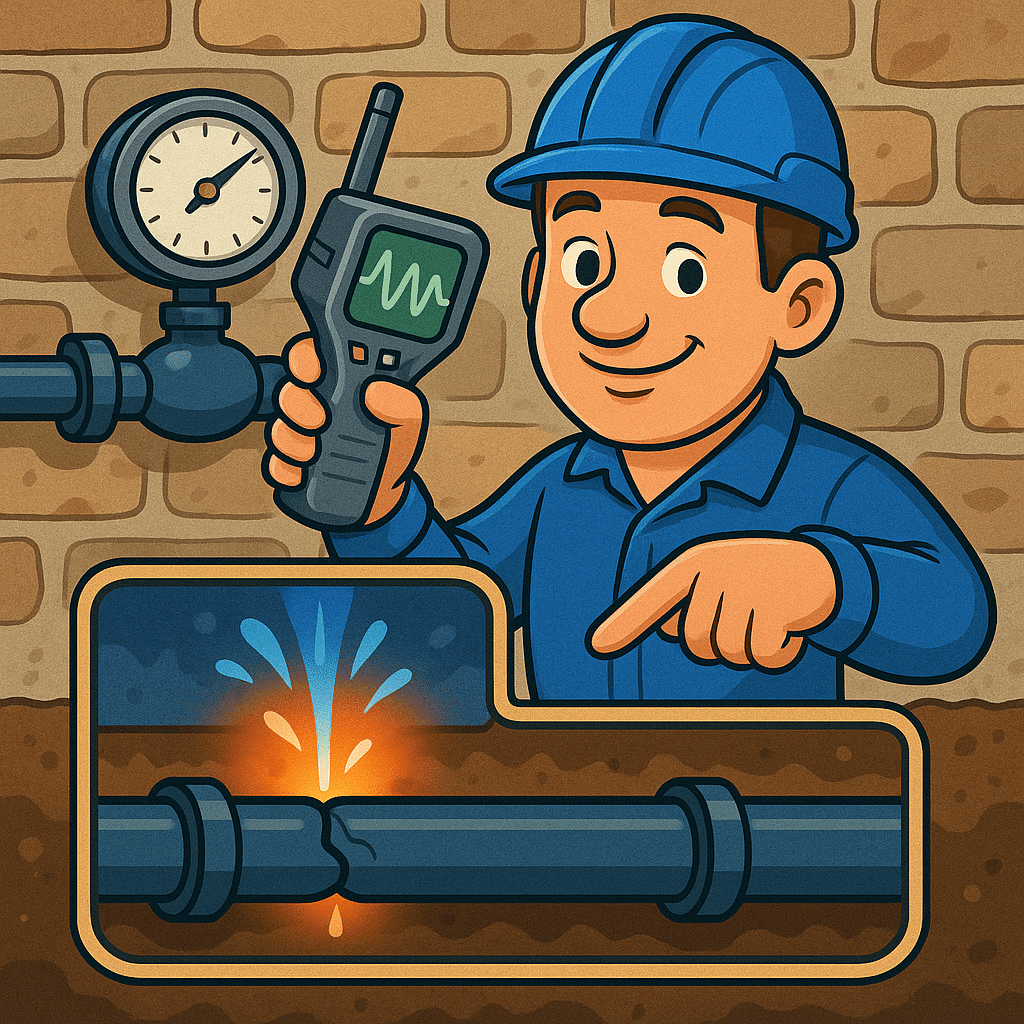
From the boundary stopcock onwards, the pipe is yours. That includes the full underground run beneath the garden, path or driveway, the point where it enters the building, and all the plumbing inside: pipes, joints, tanks, cylinders and heating pipework.
This catches out buyers of older properties in particular. The supply pipe may be sixty or seventy years old, made of lead or corroding iron, and it has been quietly ageing underground the whole time. When it finally splits, the repair, and the job of finding the split, belongs to the owner.
Because most Scottish homes are unmetered and pay for water through council tax, a leaking supply pipe does not push your bill up, and the English-style household leak allowance does not apply in Scotland (Scottish Water’s leakage FAQ covers this). The first sign is usually physical: a wet patch, a hissing stopcock or falling pressure.
If you have spotted exactly that kind of sign outside, our guide to wet patches in the garden or driveway explains how to confirm whether it is a supply pipe leak before anyone digs.
Shared supply pipes: flats, terraces and older homes
Here is the complication that most generic advice misses. In Scotland, flats and older or terraced houses usually share a single supply pipe, with one pipe branching to serve several homes. Where that is the case, responsibility for the shared section is joint between all the owners it serves (Scottish Water’s pipes FAQ confirms this).
Joint responsibility has practical consequences:
- A leak on the shared run is everyone’s problem
Even if the wet ground is in your neighbour’s garden, you may share the repair cost if the leaking section serves your home too. - Costs are normally split between the connected properties
How the split works depends on your title deeds, and on the number of homes the pipe serves. - Finding the leak settles the argument
Most shared-pipe disputes are really disputes about facts. A detection survey that shows exactly where the leak sits, on the shared run or on one owner’s private branch, usually ends the debate before it starts.
We cover the neighbour negotiations, and what happens when one owner refuses to pay, in our separate guide to shared supply pipes in Scottish flats and terraces.
Your legal duty to repair (and what happens if you ignore it)
Owning the supply pipe is not just a cost, it is a legal obligation. Under the Water (Scotland) Act, owners must repair leaks on their supply pipe. If a leak is left to run, Scottish Water can serve a formal notice requiring the repair, and if the owner still does nothing, it can carry out the work itself and charge the owner for it, as Citizens Advice Scotland explains.
In practice, Scottish Water is not looking to punish anyone. Its leakage teams find private leaks during network surveys and notify owners because treated water is being wasted. Two things are worth knowing at that point:
- Acting early keeps you in control
Once a notice is served, the timescale is no longer yours to choose. Getting the leak located and repaired before it reaches that stage is cheaper and calmer. - Help may be available
Scottish Water may offer an assisted supply pipe repair through its supply pipe repair policy in some circumstances (details in its leakage FAQ), so ask when you report the leak.
If Scottish Water has already been in touch about a suspected leak on your pipe and you are not sure the leak is real, or where it is, call us on 07700 152 467. A detection survey confirms it either way and gives you a precise repair point rather than a vague obligation.
Tenements and flats: common pipes
Tenement buildings add one more layer. Inside the building, some pipework serves a single flat and some serves the whole close. Where the title deeds do not say who maintains what, the Tenements (Scotland) Act 2004 and its Tenement Management Scheme fill the gap and govern how repair costs are shared between owners (the Act is here, and Under One Roof gives practical guidance).
The recurring tenement question is simple to state and hard to answer without evidence: is the leaking pipe a common pipe or one flat’s private pipe? The answer changes who pays entirely, which is why detection, identifying the exact pipe and the exact leak point, comes before any talk of cost splits. Our article on who pays for tenement water leaks goes into the cost-sharing rules properly.
Rented homes: the landlord’s responsibility
If you rent privately, pipe repairs are not your bill. The Repairing Standard requires landlords to keep water installations in reasonable repair and proper working order, which covers leaking pipes, tanks and heating systems (Scottish Government guidance here). Report the problem to the landlord or letting agent in writing, keep a copy, and give them the chance to arrange the repair.
Tenants still play one important role: early reporting. A slow leak reported in week one is a plumber’s visit. The same leak reported in month six is a rotted floor, a mould problem and an argument about who knew what when.
Found a leak? Work out whose it is in three steps
Step 1: Place the leak roughly
Wet ground in the street or pavement points to Scottish Water’s side. Wet ground inside your boundary, a hissing internal stopcock or damp inside the house points to the private side. Not sure? Turn off the internal stopcock: if the noise at the pipe stops, the problem is indoors; if it continues, suspect the underground supply run.
Step 2: Report or investigate accordingly
Street-side leaks: report to Scottish Water, job done. Private-side leaks: the investigation is yours to arrange. Check whether your buildings insurance includes trace and access cover, which typically pays for locating the leak and making good access afterwards.
Step 3: Pinpoint before repairing
Whoever repairs the pipe needs to know exactly where to dig or open up. Professional detection locates the leak non-destructively, using acoustic, thermal and tracer gas methods, so the repair happens in one place rather than several.
Frequently asked questions
Is the pipe under my driveway my responsibility?
Yes, if it is inside your property boundary. The supply pipe from the boundary stopcock to your house belongs to the property owner, including every metre under gardens, paths and driveways. Scottish Water’s responsibility stops at the boundary stopcock, which it owns along with the communication pipe and the main.
Who is responsible for the stopcock outside my house?
The boundary stopcock, the valve under the small lid at or near your property edge, belongs to Scottish Water, even though it controls your supply. If it is seized, damaged or leaking, report it to Scottish Water. The internal stopcock inside your home is part of your own plumbing and is yours to maintain.
Do I have to fix a leak on my supply pipe?
Yes. Under the Water (Scotland) Act, owners are legally obliged to repair supply pipe leaks. Scottish Water can serve notice requiring the repair, and if it is ignored, carry out the work and charge the owner. It may also offer an assisted supply pipe repair in some circumstances, so ask when you report it.
My neighbour and I share a supply pipe. Who pays for a leak on it?
Responsibility for a shared supply pipe is joint between the owners it serves, which is common in Scottish flats and older or terraced houses. Costs on the shared section are normally split between the connected properties. A detection survey showing exactly where the leak sits usually resolves who owes what.
Will a supply pipe leak increase my water bill in Scotland?
For most households, no. The majority of Scottish homes are unmetered and pay for water through council tax, so the charge does not change with usage, and the English-style household leak allowance does not apply. Metered businesses are different: leaks do raise their bills, though burst allowances may be claimable.
Related reading
- Shared Supply Pipes in Scottish Flats and Terraces: Who’s Responsible?
- Tenement Water Leaks: Who Pays for Repairs in Scotland?
- Wet Patch in the Garden or Driveway? Finding an Outside Leak
- Scottish Water Says You Have a Leak? What Happens Next
MCR Leak Detection provides water leak detection across Scotland, on private supply pipes, shared pipes and everything indoors.
Speak to MCR Leak Detection
Once you know the pipe is yours, the next step is knowing exactly where it leaks. We locate supply pipe and internal leaks non-destructively across Scotland, 24/7, and our report gives you a precise repair point to hand to any plumber or insurer.