
Central heating inhibitor is a chemical added to system water to slow the internal corrosion that causes pinhole leaks and sludge. Best practice under BS 7593:2019 is a water test every year and re-dosing every five years. Black water from a bleed valve means yours has already stopped working.
Central Heating Inhibitor: Cheap Insurance Against Corrosion Leaks
Most of the heating leaks we trace under Scottish floors did not start with frost, a bad joint or an accident. They started years earlier, invisibly, when the water inside the system began eating the pipework from the inside. Central heating inhibitor exists to stop exactly that, and a bottle costs less than most call-out fees.
This article explains what inhibitor actually does, why corrosion is the quiet cause behind so many pinhole leaks, how to check whether your system is protected, and what to do if the black water has already arrived.
What this guide covers
What central heating inhibitor is and what it actually does
Your heating system is a sealed loop of water in permanent contact with a mix of metals: steel radiator panels, copper pipe, brass valves, aluminium heat exchangers. Water plus mixed metals plus dissolved oxygen is a recipe for electrolytic corrosion, the same slow chemistry that rusts a neglected garden gate, except here it happens on the inside where nobody can see it.
Inhibitor is a blend of corrosion-control chemicals that coats those internal surfaces and interrupts the reaction. With a proper dose in the water, steel stops shedding rust, the water stays clear rather than turning black, and the system ages at a fraction of the unprotected rate. Without it, every year takes a measurable toll on radiator walls and buried pipe runs.
It is not a repair product. Inhibitor prevents damage; it does not reverse corrosion that has already happened, and it will not seal a leak. That distinction matters, and it is where a lot of bottle-label optimism falls down, as we cover in our honest look at central heating leak sealer.
How corrosion turns into pinhole leaks
Corrosion attacks a heating system in two ways, and both end in leaks.
First, the direct route: the reaction thins metal from the inside until, at the weakest point, it breaks through as a pinhole. Radiator panels go at their seams and bottom edges. Copper pipe pits and eventually weeps, often under floors or in screed where the first sign is a boiler losing pressure rather than any visible water. Microbore pipe, common in Scottish homes built and re-piped from the 1970s to the 1990s, has so little wall thickness that corrosion shortens its life dramatically.
Second, the indirect route: the by-product. Corroding steel sheds magnetite, the black iron oxide sludge that settles in radiator bottoms, blocks microbore runs and grinds away at pump seals and boiler components. Sludge makes the system run hotter and harder, stresses joints with repeated expansion cycles, and turns every small weep into a stained, black-streaked mess. When you see black or rusty staining around a leaking radiator valve, you are looking at the sludge signature of a system whose protection ran out some time ago.
The Scottish twist: soft water is not soft on heating systems
Scottish homeowners are used to hearing that our water is kind to plumbing, and for limescale that is true. According to the Drinking Water Quality Regulator for Scotland, most drinking water in Scotland is classified as soft, because the chalk and limestone that harden water elsewhere in Britain are largely absent here.
So the scale problems that plague English boilers are rare in Scotland. But corrosion does not care about hardness. The electrolytic reaction between mixed metals and oxygenated water runs happily in the softest loch-fed supply, which is why an unprotected system in Stirling corrodes just as surely as one in Surrey. Soft water simply changes which enemy matters: here, it is corrosion, and inhibitor is the defence.
How to tell whether your system is protected
Few homeowners know when their system was last dosed, and moving house usually erases the history entirely. The signs below do not need any equipment:
Signs your inhibitor is spent
- Black or grey bleed waterBleed a radiator into a white cup. Clear or lightly tinted water is a good sign; black water is magnetite, and the protection is gone.
- Radiators cold at the bottomA warm top and cold bottom means sludge has settled where the water should flow.
- Repeated boiler part failuresPumps, diverter valves and heat exchangers dying young often share one cause: dirty, corrosive system water.
- Stained weeps at jointsRusty or black crust at valves and joints marks corrosive water finding its way out.
- No record of dosingIf nobody can say when inhibitor last went in, assume it needs testing. Protection quietly dilutes away with every top-up and every partial drain-down.
There is also a formal answer. British Standard BS 7593:2019, the code of practice for heating system water, calls for an annual system water test as part of servicing, with chemical inhibitors re-dosed every five years or a laboratory water test undertaken to prove the chemicals still work. If your boiler service has never included a water check, it is worth asking for one by name.
Topping up inhibitor, and why magnetic filters earn their place
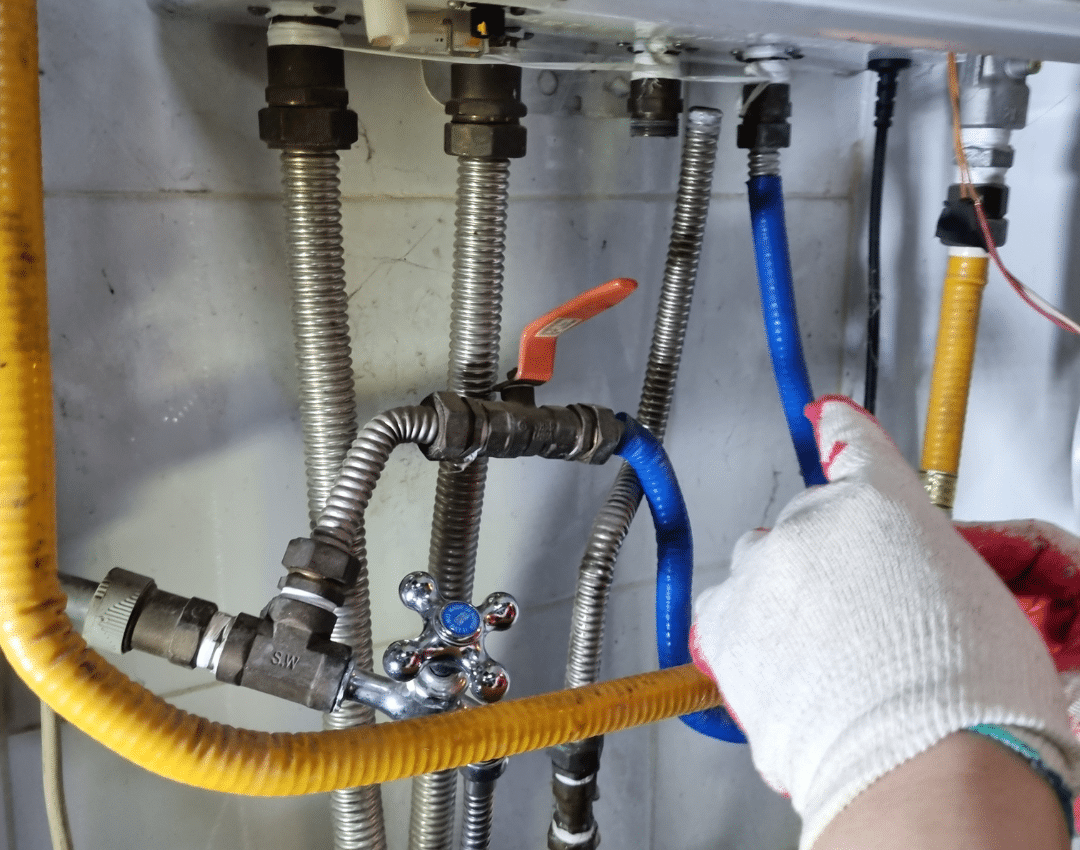
Adding inhibitor is a routine job. On a sealed system it goes in through a radiator (via the bleed point with a dosing adaptor or by removing a plug), through a towel rail, or through a magnetic filter with a dosing point. Open-vented systems take it through the header tank in the loft. One standard bottle typically treats an average family system; bigger systems need more, and the label maths is worth doing rather than guessing.
Every top-up of fresh water dilutes the dose, which is why a system that needs regular repressurising never stays protected for long. If you are topping up more than the occasional repressurise, fix the reason first.
A magnetic filter is the natural partner. Plumbed into the return pipe near the boiler, it pulls circulating magnetite out of the water before it settles anywhere important, and a service engineer can empty it in minutes. Filter catches the sludge, inhibitor stops more being made. Together they are the cheapest protection a heating system can carry.
If corrosion has already caused a leak
Sometimes the black water arrives with a symptom attached: a pressure gauge that keeps falling, a damp patch with rusty edges, a ceiling stain below a heating run. At that point the order of operations matters. Find the leak, repair it, then clean and re-dose the system, because fresh inhibitor poured into a leaking system simply escapes with the water.
Corrosion leaks are usually pinholes, and pinholes hide. They sit under floorboards, inside screed and behind plasterboard, weeping a litre at a time into the building fabric. Our engineers trace them non-destructively with thermal imaging, acoustic equipment and tracer gas, following the process in our guide to finding a leak in a central heating system. If your gauge is falling and the bleed water is black, call us on 07700 152 467 before the search involves a crowbar.
One more honest note: a system that has produced one corrosion pinhole can produce another, because the same water touched every pipe. A repair plus water treatment plus a filter gives the system a genuine second life. A repair alone is a pause button.
Frequently asked questions
How often should central heating inhibitor be topped up?
Best practice under BS 7593:2019 is an annual system water check as part of servicing, with inhibitor re-dosed every five years or a laboratory water test done to confirm protection. Top up sooner after any work that drains water from the system, because the dose dilutes every time fresh water goes in.
Can inhibitor stop an existing leak?
No. Inhibitor prevents the corrosion that causes future leaks, but it has no sealing action and cannot close a hole that already exists. A leaking system needs the leak found and repaired first, then cleaning and fresh inhibitor to protect the repair and the rest of the pipework.
What happens if a heating system has no inhibitor?
Electrolytic corrosion runs unchecked between the steel, copper and aluminium in the system. Radiators shed black magnetite sludge, efficiency drops, boiler parts wear early, and metal thins until pinhole leaks appear, often in hidden pipework. The damage builds over years, which is why it surprises people.
Does soft Scottish water mean I can skip inhibitor?
No. Soft water, which the Drinking Water Quality Regulator confirms covers most of Scotland, means limescale is rarely a problem here, but corrosion happens regardless of hardness. An unprotected Scottish system corrodes just like any other, so the inhibitor dose matters just as much.
Is black radiator water dangerous?
Not to your health, since heating water never mixes with your taps, but it is bad news for the system. Black water is magnetite from corroding steel, and it means protection has failed. Left alone it blocks radiators and microbore pipe, wears out pumps and ends in pinhole leaks, so treat it as a prompt to act.
Related reading
- Leaking Radiator Valve? Causes, Quick Fixes and When to Worry
- Boiler Losing Pressure? Causes and What to Do Next
- How to Find a Leak in a Central Heating System
MCR Leak Detection provides professional leak detection across Scotland, including central heating and corrosion-related leaks.
Speak to MCR Leak Detection
Black bleed water and a falling gauge usually mean a pinhole somewhere you cannot see. We trace corrosion leaks non-destructively across Scotland, 24/7, and mark the repair point before anything gets opened up.