

It depends where the leak is. Scottish Water pays for the main and the communication pipe up to your boundary. You pay for the supply pipe and everything inside your home. Shared pipes split the cost with neighbours, and buildings insurance often covers finding the leak and repairing the damage it caused.
Who Pays When There’s a Water Leak? Owner, Neighbour or Scottish Water
The water is pooling, someone needs to fix it, and nobody wants the bill. Before any phone calls get heated, there is one question that settles almost every dispute about who pays for a water leak in Scotland: where, exactly, is the leaking pipe?
Once you know that, the law does most of the deciding for you. This guide walks through each possible location, who is liable in each case, and where your insurance can step in. It is written for Scotland specifically, because the rules here are not the same as the advice you will find on English water company websites.
What this guide covers
Who pays for a water leak? Start with where it is, not whose fault it is
Water pipe responsibility in Scotland splits at your property boundary. According to Scottish Water’s guidance on who fixes leaks, Scottish Water owns the water main in the street, the communication pipe that runs from the main to your boundary, and the boundary stopcock. The homeowner owns the supply pipe from the boundary into the house, plus every drop of internal plumbing, including pipes buried under the garden or driveway.
That single fact decides most cases. The complication is that a leak rarely announces its address. Water tracks along pipework, under monoblock and through walls, so the wet patch you can see is often metres from the pipe that failed. That is why liability arguments between neighbours, insurers and factors so often stall until someone locates the leak properly. We cover the ownership map in more detail in our guide to who is responsible for water pipes in Scotland.
| Where the leak is | Who usually pays in Scotland |
|---|---|
| Water main in the street | Scottish Water |
| Communication pipe (main to your boundary) | Scottish Water |
| Boundary stopcock | Scottish Water |
| Supply pipe (boundary to your home) | You, the owner |
| Shared supply pipe (flats, terraces) | All owners it serves, jointly |
| Internal plumbing and heating | You, often with insurance help |
| Neighbour’s pipe or common tenement pipe | The neighbour, or shared under tenement law |
When Scottish Water pays
If the leak sits on the network side of your boundary, it is Scottish Water’s job and Scottish Water’s cost. That covers burst mains, leaking communication pipes and faulty boundary stopcocks. You can report these on their website or by phone, and you should: a communication pipe leak can soak your garden for weeks while everyone assumes it is private.
Be prepared for the boundary question to matter. If Scottish Water attends and traces the leak to your side, the job bounces back to you. If they have already surveyed your street and left a notice about a suspected leak, our article on what happens after Scottish Water says you have a leak explains the process that follows.
When you pay: the supply pipe and everything inside
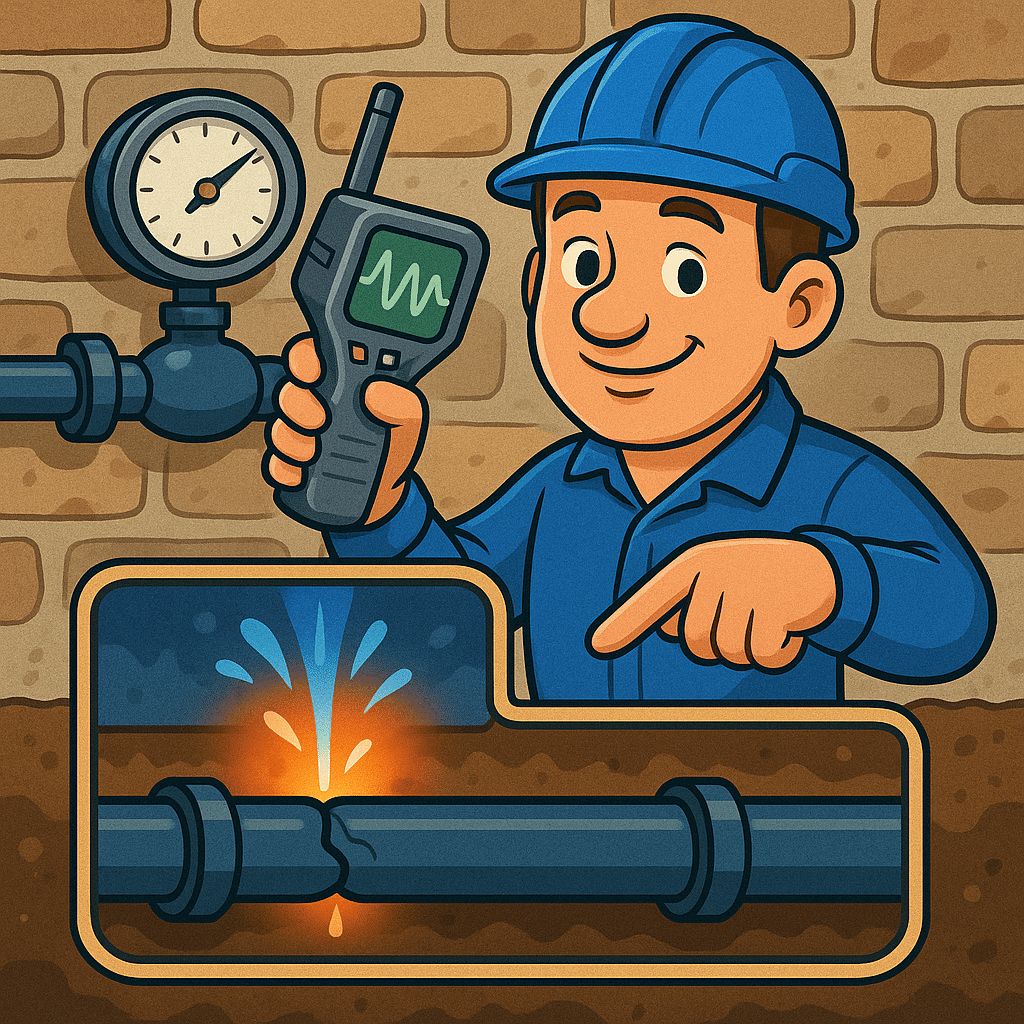
The supply pipe is yours, even the stretch buried under your lawn or driveway that you have never seen. And this is not just a housekeeping point. Under the Water (Scotland) Act, owners are legally obliged to repair supply pipe leaks. Citizens Advice Scotland confirms that Scottish Water can serve notice on an owner who does not act, carry out the repair itself and charge the owner for the work.
In practice, Scottish Water prefers cooperation to enforcement. Its leaks and leakage FAQ notes that it may offer an assisted supply pipe repair through its supply pipe repair policy, so it is always worth asking before you commission private work.
Either way, the finding comes first. A supply pipe repair quote means little until someone can point at the failure. Non-destructive detection narrows a buried leak to a small marked spot, which turns a trench across the whole garden into a single neat excavation.
Shared supply pipes: flats, terraces and older streets
Here is the wrinkle that catches out a lot of Scottish owners. Flats and older or terraced houses usually share a single supply pipe, and Scottish Water’s pipes FAQ is clear that responsibility for a shared pipe is joint among the owners it serves. A leak on the common section is everyone’s problem, even if it only surfaces in one garden.
That means the repair bill, and usually the detection bill, gets split. It also means one refusing neighbour can hold things up, which is exactly when a written report locating the leak precisely becomes useful evidence. We have a full guide to shared supply pipes in Scottish flats and terraces covering how the costs get divided.
Leaks inside your home: where insurance fits
Inside the house, the pipework is yours, so the repair of the pipe itself is normally your cost. Buildings insurance picks up two other things, and they are usually the expensive ones: the damage the water caused, and the cost of finding the leak.
That second part is trace and access cover. It pays to locate the leak and make good the access afterwards, though not to fix the pipe itself. Most buildings policies include it. MoneySuperMarket, citing Defaqto, puts the figure at 94 per cent of policies, with typical limits between £5,000 and £10,000. Check your schedule before you assume, and read our plain-English guide to what trace and access cover actually pays for.
Sources: MoneySuperMarket trace and access guide and Scottish Water Burst Allowances.
One honest warning from the claims we get involved in: insurers pay for sudden escapes of water far more readily than slow ones. A leak that has clearly dripped for months invites a gradual-damage argument. Finding leaks early is not just about the water, it protects your claim.
Not sure yet whose pipe has failed, or whether this is even claimable? That is precisely the question a detection survey answers. Call us on 07700 152 467 and we will locate the leak, identify whose pipe it is on, and give you a written report you can put in front of an insurer, a neighbour or Scottish Water.
Leaks from a neighbour’s property or the flat above
When the water is coming through your ceiling but the pipe is upstairs, the starting point is simple: the owner of the failed pipe is responsible for repairing it. If it is a pipe that serves only the flat above, that owner deals with it, and their insurer (or yours) usually handles the damage below.
Tenements add a layer. Some pipes in a tenement serve the whole building, and for those the Tenements (Scotland) Act 2004 and its Tenement Management Scheme govern how repair costs are shared when the title deeds are silent. A common supply pipe failure can therefore be a shared bill across every flat, not just the one where it leaked. Under One Roof has practical guidance on the flat-above scenario, and our article on water leaks from the flat above in Scotland goes deeper.
In every neighbour dispute we attend, the argument shortens dramatically once someone can prove whose pipe failed. That is usually the real value of the detection visit.
What about your water bill?
Here is where Scotland genuinely differs from England, and where a lot of online advice goes wrong. Most Scottish households pay for water through their council tax, without a meter. Scottish Water confirms that a leak does not increase an unmetered household’s water bill, and the English-style household leak allowance does not apply here. For a Scottish homeowner, the cost of a leak is the repair and the damage, not the water.
Businesses are different. They are metered and billed through Licensed Providers, so a leak burns money by the day. The good news is that a Burst Allowance exists: Scottish Water’s policy allows up to nine months’ allowance for biannually read meters and a 50 per cent water-and-waste allowance for private leakage, claimed through providers such as Business Stream. You will need evidence: the repair date, the estimated leak start, a plumber’s or detection report, and two meter readings a week apart after the repair. The full rules are covered in the related reading below.
Quick decision checklist
- Leak before your boundaryReport it to Scottish Water. Their pipe, their cost.
- Leak on your supply pipeYour repair, by law. Ask Scottish Water about assisted repair, check trace and access cover, get it located before anyone digs.
- Shared pipeJoint cost with every owner the pipe serves. Get it located and put the findings in writing.
- Inside your homeYour pipe repair, but insurance often covers detection and damage.
- Neighbour or tenementThe pipe owner pays; common pipes are shared under the Tenement Management Scheme.
Frequently asked questions
Who pays for a water leak under my driveway?
If the pipe under the driveway is your supply pipe, you do, because owners in Scotland are responsible for the supply pipe from the boundary into the home. Trace and access cover on buildings insurance often pays to locate the leak and make good the surface, so check your policy before digging.
Will Scottish Water fix a leak on my property?
Not usually at their cost, because pipes on your side of the boundary belong to you. Scottish Water may offer an assisted supply pipe repair under its supply pipe repair policy, and it can also serve notice requiring you to fix a leaking supply pipe, then charge you if it does the work itself.
Who pays when the leak comes from the flat above?
The owner of the failed pipe repairs it, and insurers usually sort the damage between them. If the leaking pipe serves the whole building, the Tenements (Scotland) Act 2004 and the Tenement Management Scheme can make the repair a shared cost across all owners. Proving whose pipe failed is the first step.
Does insurance pay to find the leak as well as fix the damage?
Often, yes. Trace and access cover pays for locating the leak and making good the access afterwards, and MoneySuperMarket (citing Defaqto) says 94 per cent of buildings policies include it, typically up to £5,000 or £10,000. The pipe repair itself normally sits outside that cover.
Do I get money off my water bill for a leak in Scotland?
Households generally do not, because most Scottish homes are unmetered and pay through council tax, so a leak never touches the bill. Metered businesses can claim a Burst Allowance through their Licensed Provider, with up to nine months’ allowance and 50 per cent relief on private leakage, if they supply the evidence.
Related reading
- Who Is Responsible for Water Pipes in Scotland?
- Tenement Water Leaks: Who Pays for Repairs in Scotland?
- Does Home Insurance Cover Water Leaks? Escape of Water Explained
- Leak Allowances in Scotland: The Rules for Homes and Businesses
MCR Leak Detection provides water leak detection across Scotland for homeowners, landlords, factors and businesses.
Speak to MCR Leak Detection
Liability arguments end when the leak is found. We locate leaks non-destructively anywhere in Scotland, 24/7, and provide a written report that tells you exactly whose pipe failed and where.