

Most radiator valve leaks come from the gland nut, the union to the radiator or a failed olive inside a compression joint. A quarter-turn on the right nut often stops the weep. But rusty crust, black staining or a boiler that keeps losing pressure points to corrosion, and that deserves a proper look.
Leaking Radiator Valve? Causes, Quick Fixes and When to Worry
A leaking radiator valve is one of the most common heating faults in any Scottish home, and one of the most misjudged. Nine times out of ten it is a small, cheap job. The tenth time it is the visible tip of system-wide corrosion that is quietly eating pipework you cannot see.
This guide shows you how to work out which one you have. We cover where valves actually leak, the safe fixes you can try yourself, and the specific signs that tell us, as leak detection engineers, that a weeping valve is the least of a system’s problems.
What this guide covers
First, find where the valve is actually leaking
Dry everything with a towel, then wrap a sheet of dry toilet paper around each part of the valve in turn and wait a few minutes. The wet spot tells you which joint is crying. There are only four realistic candidates:
- The gland, under the cap or headWater creeps up the spindle, the little shaft the valve head turns. This is the most common weep of all and often the easiest to stop.
- The union nut to the radiatorThe large nut connecting valve to radiator tail. Weeps here usually mean the joint needs a careful nip or fresh jointing.
- The compression nut to the pipeBelow the valve, where it grips the pipe. Inside is a soft brass ring called an olive; when it fails or was fitted badly, the joint seeps.
- The valve body itselfRare, but pinholes do happen on old or corroded valves. A body leak means replacement, not tightening.
Also check the bleed screw at the top corner of the radiator while you are there. A loose bleed screw imitates a valve leak convincingly, because water runs down the panel and drips off the valve.
TRV, lockshield or wheelhead: does it matter?
It matters for one practical reason: knowing which valve you are looking at tells you what you can safely touch.
| Valve | What it looks like | Leak habits |
|---|---|---|
| TRV (thermostatic) | Numbered head, usually 1 to 5 | Gland weeps under the head, especially on valves that sat untouched all summer |
| Lockshield | Plain domed cap, often plastic | Forgotten and rarely serviced, so weeps go unnoticed until the carpet stains |
| Wheelhead (manual) | Simple twist wheel | Gland packing wears with regular use and starts to seep |
The lockshield deserves a special mention. Because nobody ever kneels down to look at it, a lockshield can weep for months unseen. If a radiator corner smells musty or the flooring near one end looks darker, lift the cap and check it with dry tissue.
Why radiator valves leak in the first place
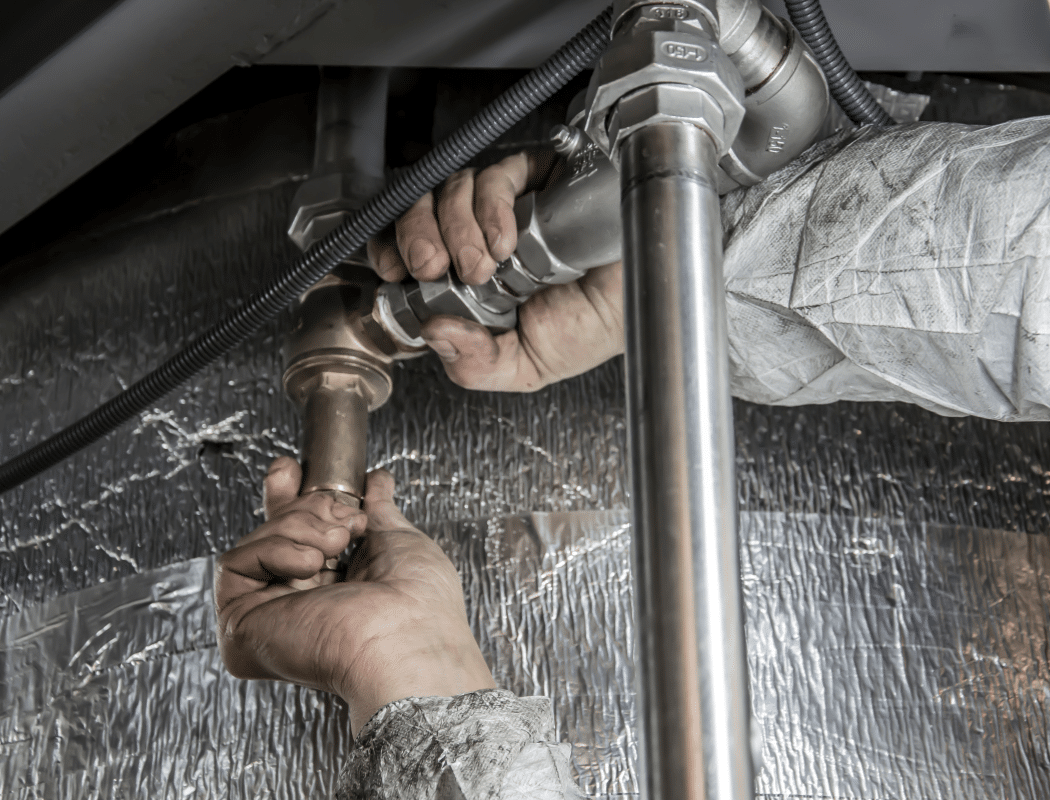
Gland packing is the usual culprit. Inside the valve, the spindle passes through a packed seal, and every time the valve is turned the packing wears a little. Old wheelheads and seized TRVs that get forced in autumn are classic victims.
Olives fail differently. A compression olive only seals properly when it was tightened correctly the first time. Over-tightened olives crush and crack; under-tightened ones never quite bite. Either can hold for years, then let go when the joint is disturbed, which is why leaks so often appear after carpets are fitted or radiators are repainted.
Then there is corrosion. Heating water with spent inhibitor turns mildly acidic and carries black magnetite sludge around the system. Joints weep, and the leak leaves a tell-tale signature: black or rusty staining rather than clean water marks. That signature changes the diagnosis entirely, as we cover below.
Quick fixes for a leaking radiator valve you can try today
Work gently. Brass fittings on old Scottish systems have been hot and cold a few thousand times, and brute force turns a weep into a flood. Keep a towel and a small container handy before touching anything.
Step 1: Nip the gland nut a quarter turn
Pull off the valve head or cap to expose the small nut around the spindle. Hold the valve body steady with one spanner and turn the gland nut clockwise a quarter turn with another. Dry it, wait ten minutes, check with tissue. One more quarter turn is the sensible maximum.
Step 2: Repack with PTFE if the gland still weeps
Undo the gland nut, wind a few turns of PTFE tape down around the spindle, gently push it into the gland with a small screwdriver and retighten. This old trade fix buys years on a valve that is otherwise sound.
Step 3: Nip a weeping union or compression nut
Same technique: two spanners, quarter turn, then stop and watch. If a compression joint still seeps after a careful nip, the olive has failed and tightening harder will crack it. That joint needs remaking, which means draining down to below the leak.
Step 4: Contain and monitor anything you cannot stop
A container under the drip and a mark on your boiler’s pressure gauge turn a worry into data. If pressure keeps sliding faster than the drip explains, more water is escaping than you can see, and that changes the job. Our guide to repressurising a boiler safely covers topping up while you wait for the repair.
What we would rather you did not do: force a seized valve, keep cranking a nut that has stopped responding, or tip leak sealer into the system to silence a valve weep. Sealer belongs nowhere near a fault you can see and reach with a spanner.
When a weeping valve means something bigger
Here is the honest trade view. A clean-water weep on one gland nut is a maintenance job. But some valve leaks are symptoms, not faults, and these are the signs that make us look past the radiator:
- Black or rusty staining at the leakMagnetite staining means the system water is corrosive, and the same water is sitting inside every pipe run under your floors. Where inhibitor has run out, the valve weep is the visible failure; the invisible ones follow.
- Crusty green or white deposits on several jointsMultiple weeping joints on one system is a pattern, not a coincidence, and usually points to system-wide corrosion or repeated pressure cycling.
- Boiler pressure falling faster than the drip explainsA drip you can catch in an egg cup does not empty a sealed system weekly. If yours needs topping up that often, read our guide to a boiler losing pressure, because a second, hidden leak is likely.
- Damp or staining away from the radiatorWater on the floor two metres from any valve did not come from the valve. Heating pipes under the floor are the suspects, covered in our article on central heating pipes leaking under the floor.
If any of those match what you are seeing, do not lift floorboards on a hunch. Call us on 07700 152 467 and we will pinpoint the leak first, non-destructively, anywhere in Scotland.
When to call someone in, and who to call
For a valve that needs replacing or a compression joint that needs remaking, any competent plumber or heating engineer is the right call. It is routine work: drain down, swap the valve or olive, refill, and add fresh inhibitor while the system is open.
Leak detection earns its keep when the question is not how to fix the leak but where the water is actually going. Repeated pressure loss with dry valves, staining that does not line up with any visible pipe, or a weep that returns no matter how many parts get replaced: that is instrument territory. Thermal imaging and tracer gas find the failure point without exploratory demolition, and the process is covered in our walkthrough of finding a leak in a central heating system.
Frequently asked questions
Can I fix a leaking radiator valve myself?
Often, yes. Tightening a gland nut a quarter turn or repacking the gland with PTFE tape are safe DIY jobs if you work gently with two spanners. Remaking a compression joint or replacing the valve means draining part of the system, which is where many people sensibly hand over to a plumber.
Do I need to drain the radiator to fix a leaking valve?
Not for a gland weep, which can be fixed from outside the sealed waterway. You do need to drain down to replace a valve, remake an olive or swap the radiator tail, because those joints hold back system water. On a sealed system, remember the pressure needs topping up again afterwards.
Why does my radiator valve only leak when the heating is on?
Heat makes metal expand and raises system pressure, so a marginal seal that holds cold can weep hot. Gland packing and tired olives both behave this way. It is still a real leak, and the on-off pattern is worth mentioning to whoever repairs it because it narrows the diagnosis.
Is a leaking radiator valve an emergency?
A slow weep is not, provided you contain it and keep an eye on boiler pressure. It becomes urgent when water flows rather than drips, when it is coming through a ceiling below, or when pressure loss suggests a bigger hidden escape. In those cases isolate the radiator using both valves and get help the same day.
What is the black water coming from my radiator valve?
Black water is magnetite, iron oxide sludge created as radiators and steel pipework corrode from the inside. It means the system’s inhibitor is spent or was never added. Fix the valve, but also get the system water treated, because corrosive water goes on to cause pinhole leaks in pipework you cannot see.
Related reading
- Boiler Losing Pressure? Causes and What to Do Next
- How to Find a Leak in a Central Heating System
- Central Heating Pipe Leaking Under the Floor: Signs and What to Do
MCR Leak Detection provides professional leak detection across Scotland, including central heating systems.
Speak to MCR Leak Detection
Fixed the valve but the pressure keeps falling? We trace hidden heating leaks non-destructively with thermal imaging and tracer gas, Scotland-wide and 24/7, so the next repair is the right one.