

Low pressure at one tap is almost never a leak. Low pressure across the whole house, when neighbours are unaffected and Scottish Water reports no local work, often means water is escaping from your supply pipe. A gradual decline over weeks fits a growing leak; a sudden drop fits a burst.
Low Water Pressure: When It Means a Leak (and When It Doesn’t)
The shower has turned feeble, the kitchen tap takes an age to fill the kettle, and someone in the house has asked whether the pipes are on their way out. Low water pressure has a dozen possible causes. A low water pressure leak on your supply pipe is only one of them, but it is the one that gets expensive when ignored, so it pays to rule it in or out quickly.
The pattern of the pressure loss does most of the diagnostic work for you. Where it happens, how fast it arrived and whether the neighbours share it will usually point to the answer before any equipment comes out. Here is how we read those clues on real callouts.
In this guide
First question: one tap or the whole house?
This single observation eliminates half the possibilities.
If only one outlet is weak, the problem lives at that outlet or on its branch pipework. A blocked tap aerator, a limescaled shower head, a partially closed isolation valve under the basin or a kinked flexible hose are all far more likely than a leak. Unscrew the aerator, soak the shower head in descaler, check the little valves are fully open. Most single-outlet cases end there.
If every cold tap in the house is weak, something is wrong between the water main and your kitchen. That means the boundary stopcock, the supply pipe under your garden or driveway, the stopcock inside the house or the main itself. A leak becomes a live possibility, because water escaping through a hole in the supply pipe never reaches your taps, and the friction of feeding a leak drags the pressure down everywhere.
One more variant: if hot taps are weak but cold taps are fine, the restriction is inside your hot water system (often the boiler, cylinder or a scaled heat exchanger) rather than the supply. That is a job for a heating engineer, not a leak survey.
Sudden drop vs gradual decline
The speed of the change is the second big clue.
| Pattern | Most likely explanation |
|---|---|
| Sudden drop, whole house, today | A burst pipe (yours or the network), a closed or failing stopcock, or Scottish Water working nearby |
| Gradual decline over weeks or months | A supply pipe leak slowly getting bigger, or old steel pipework slowly corroding shut |
| Worse at peak times only | Network demand, common on shared supplies and at the end of long rural mains |
| Fluctuating day to day | Network operations, a failing pressure reducing valve, or a shared supply neighbour’s usage |
Gradual decline is the pattern that worries us most, because it is exactly how an underground leak behaves. A pinhole in a buried pipe erodes into a bigger hole month by month. The pressure falls so slowly that households adjust without noticing, until someone visits and asks why the shower is so weak.
Four low water pressure leak checks to run yourself
Check 1: ask a neighbour
If next door’s pressure has dropped too, the cause is almost certainly the network or a shared supply pipe, not your plumbing. Two minutes on the doorstep can save a callout fee.
Check 2: look at Scottish Water’s website
Scottish Water publishes live information about bursts and planned work by postcode. If there is an incident in your area, low pressure is expected and temporary.
Check 3: confirm both stopcocks are fully open
A stopcock nudged half-shut during other work is a classic false alarm. Check the indoor one first (our guide to finding your stopcock helps) and open it fully, then back a quarter turn. Older gate valves can also fail inside and choke the flow even when the handle says open.
Check 4: the silence test
Turn off every tap and appliance, then listen at the indoor stopcock on a quiet evening. A constant hiss or rush through the pipe when nothing is running means water is passing through, and if nothing in the house is using it, it is escaping somewhere.
If check 4 gives you a constant noise, or checks 1 to 3 come back clear and the pressure is still poor, you are into leak territory. If you would rather have it confirmed properly before anyone digs anything, call us on 07700 152 467 and we will locate it first.
When the supply pipe is leaking
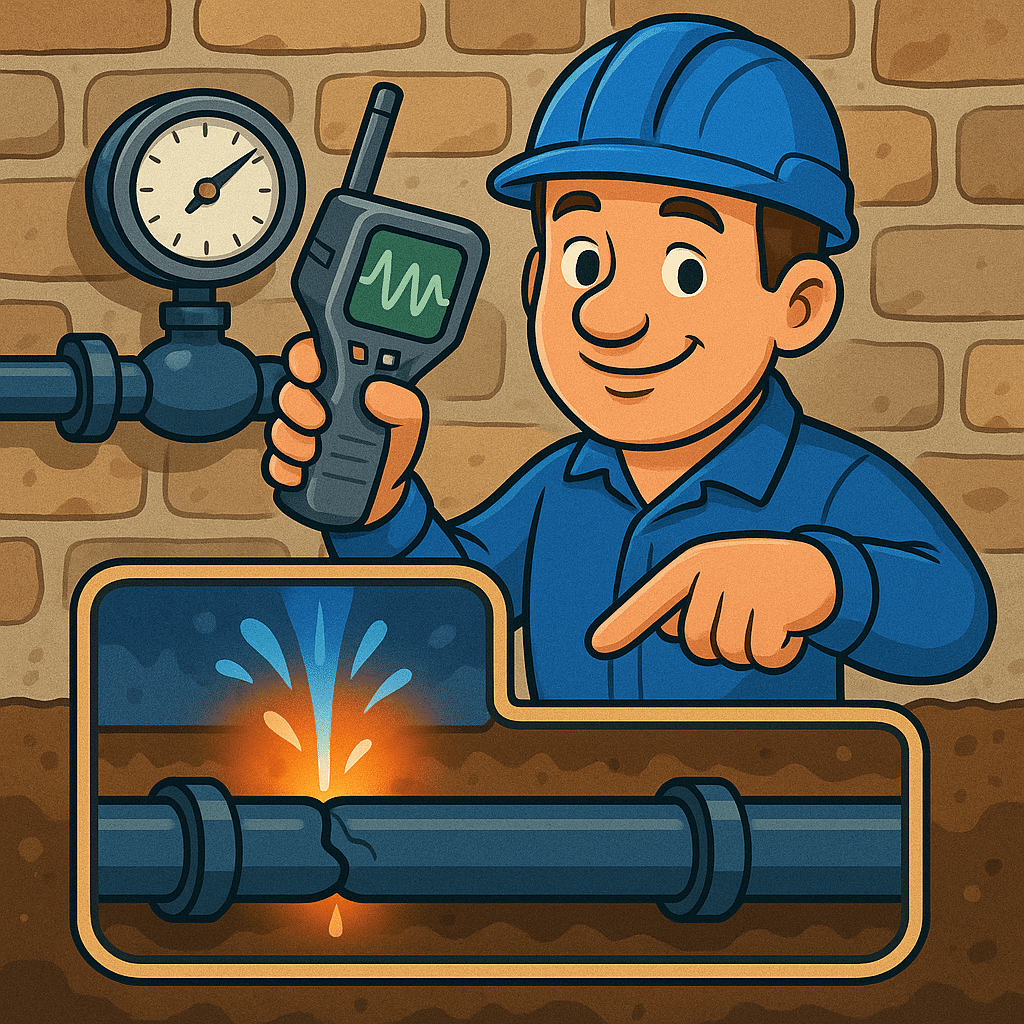
The supply pipe is the buried pipe running from the boundary stopcock to the stopcock inside your home, usually under the front garden, path or driveway. Under Scottish rules, Scottish Water owns the main and the communication pipe up to your boundary, and the homeowner owns the supply pipe from the boundary into the house. A leak on that stretch is yours to deal with.
Alongside the pressure loss, look for a patch of ground that stays wet in dry weather, unusually lush grass along one line, moss thriving between monoblock setts, or the sound of running water near the boundary. Our guide to wet patches in the garden or driveway covers these outdoor signs in detail.
Supply pipe leaks do not fix themselves, and the law does not let you sit on them either. Owners are obliged to repair leaking supply pipes, and Scottish Water can serve notice and carry out the repair at the owner’s cost if nothing is done, as Citizens Advice Scotland explains. The sensible order of work is to locate the leak precisely, then repair one small excavation, rather than digging up a driveway on a guess. That location step is what we do with acoustic and tracer gas equipment, described in our guide to finding an underground water leak.
When it is Scottish Water’s problem, not yours
Plenty of pressure complaints have nothing to do with the property. Bursts on the local main, planned mains work, valve operations and seasonal demand all knock pressure down, sometimes for days. The giveaways are that neighbours are affected too and that the change arrived suddenly without any other symptom at your property.
If your home is a flat or an older terraced house, there is another possibility between “your pipe” and “their main”: a shared supply pipe serving several properties, which is common in Scotland and is jointly the owners’ responsibility according to Scottish Water’s pipes FAQ. One neighbour running a bath can drop everyone’s pressure, and a leak on the shared pipe affects the whole row. We cover who pays and how to investigate in our guide to shared supply pipes in Scotland.
Innocent causes worth ruling out
- Scaled or blocked fittingsAerators, shower heads and flexible hose filters clog gradually. They mimic a gradual decline, but only at their own outlet.
- A failing pressure reducing valveHomes fitted with a PRV on the incoming main can see pressure sag or fluctuate as the valve ages. A plumber can test and replace it.
- Old indoor pipeworkOriginal galvanised steel pipes in pre-war housing corrode from within and narrow like a furred artery. Pressure at the stopcock is fine; flow at the taps is poor. This is a repiping conversation, not a leak.
- Demand inside the houseCombi boilers, garden taps and running appliances all steal flow. If pressure only dips when something else is running, the supply is simply working at its limit.
What to do next
Run the four checks. If the neighbours are fine, Scottish Water reports nothing, both stopcocks are open and the silence test still gives you noise, the evidence points at a leak on your side. At that point resist the urge to dig. A leak survey with acoustic listening, tracer gas and thermal imaging will put an X on the ground, typically within a brick or two of the actual hole, and turns a trench through the garden into a single neat excavation. That is the core of what we do as part of water leak detection across Scotland.
Speak to MCR Leak Detection
Whole-house pressure loss with no network explanation usually means a supply pipe leak. Our engineers locate it non-destructively, anywhere in Scotland, 24/7, so the repair is one small hole rather than a dug-up drive.
Frequently asked questions
Can a small leak really cause low water pressure?
A pinhole will not usually move the pressure noticeably. By the time whole-house pressure drops, the leak is typically passing a serious volume, often underground where nothing shows on the surface. That is why gradual pressure decline deserves investigation rather than a wait-and-see approach.
Why is my water pressure low only at night or in the morning?
Time-of-day patterns point to demand, not leaks. Morning and evening peaks stretch the network, especially on shared supplies and long rural mains. A leak drags pressure down around the clock, so pressure that recovers at quiet times is rarely caused by one.
Who do I call first: Scottish Water or a plumber?
Check Scottish Water’s website for incidents in your postcode first. If the network is clear and neighbours are unaffected, the problem is on your side of the boundary. A leak detection survey then makes sense before repair work, because it tells the plumber exactly where to dig.
Will my water bill show a supply pipe leak in Scotland?
Usually not. Most Scottish households pay for water through council tax rather than a meter, so a leak changes nothing on paper. Physical signs, including pressure loss, wet ground and the sound of running water, are normally the only warnings an unmetered home gets.
My pressure dropped suddenly and the neighbours are fine. Is that an emergency?
Treat it seriously. A sudden whole-house drop with no network cause suggests a burst on your supply pipe, and buried bursts can wash out ground under paths and foundations. Check for wet ground and running water sounds, and get the pipe traced quickly rather than waiting for surface damage.
Related reading
- Wet patch in the garden or driveway? Finding an outside leak
- How to find an underground water leak (and who to call)
- Who is responsible for water pipes in Scotland?
- Shared supply pipes in Scotland: who pays?
Or learn more about our water leak detection service across Scotland.