
Your stopcock is most often under the kitchen sink, where the mains pipe enters the house. Other common spots: a hall cupboard, under the stairs, the bathroom or a downstairs WC. Turn it clockwise to shut off the water. In many Scottish tenements the valve sits in a shared close or under the communal stair, so find yours today, not during a burst.
Where Is My Stopcock? How to Shut Off Your Water in an Emergency
When a pipe bursts, water comes fast. A typical mains-fed pipe can put litres on the floor every minute, and the single most useful thing anyone in the house can do is close the stopcock. The problem is that most people ask “where is my stopcock?” for the first time while water is pouring through a ceiling.
This guide shows you where the valve usually hides in each type of home, what the arrangement looks like in Scottish flats and tenements, and how to test it now so it actually turns when it matters.
In this guide
What a stopcock does (and what it does not)
The internal stopcock, also called a stop valve or stop tap, sits on the incoming mains pipe and controls every cold outlet fed directly from the mains. Close it and the flow into the house stops. It usually looks like a brass valve with a T-shaped or wheel head, roughly the size of an outdoor tap.
Two things it does not do. It will not instantly empty the pipes, so water already in the system can keep dripping for a few minutes, and it will not stop a leak on your central heating circuit, which is a sealed loop topped up from its own filling point. For a heating leak, the boiler pressure gauge is the tell, and our guide to boiler pressure loss covers that side.
Where is my stopcock? Check these places in order
The valve is nearly always where the mains pipe first enters the building, at ground level, on an outside-facing wall or close to one. Work through this list.
| Home type | Most likely locations |
|---|---|
| Post-war house or bungalow | Under the kitchen sink, at the back of the cupboard |
| Victorian or older stone house | Under the stairs, in a hall cupboard, in the cellar, or under a floorboard hatch near the front door |
| Modern build (roughly 1990s on) | Kitchen sink cupboard, utility room, garage, or a white plastic access panel near the front door |
| Tenement or converted flat | Under the kitchen sink or bathroom floor, or on a shared pipe in the close or under the communal stair |
| Modern apartment block | In a utility cupboard inside the flat, often beside the boiler, or in a landlord riser cupboard on the landing |
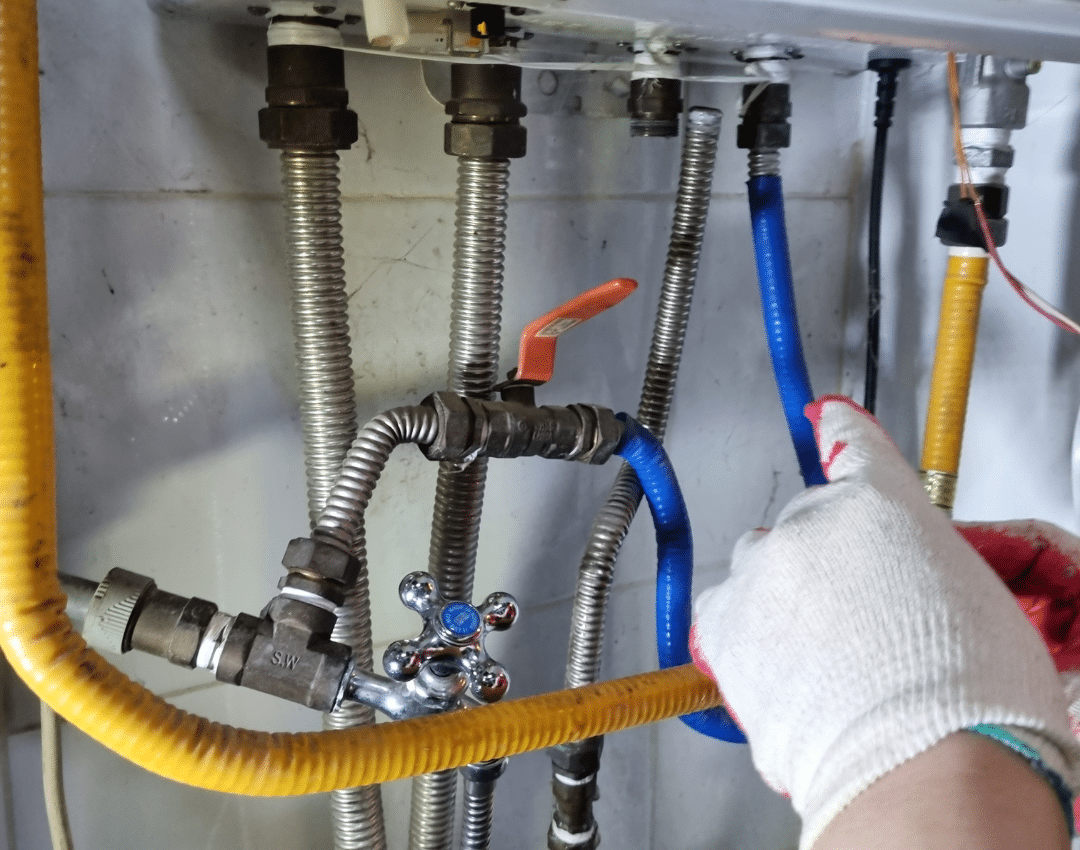
Do not confuse the stopcock with the smaller isolation valves fitted on individual pipe runs, the little slotted valves behind toilets and under taps. Those shut off one appliance. The stopcock shuts off the house.
If you follow the cold pipe from your kitchen tap downwards and backwards, it will lead you to the valve in most homes.
Flats and tenements: the Scottish complication
In many traditional Scottish tenements, the mains supply rises through the building on a shared pipe, and older flats sometimes share stop valves too. Yours may be in the close, under the communal stair, or in a neighbour’s flat if the building has been subdivided over the years. Scottish Water notes that flats and older terraced properties commonly share a single supply pipe, with responsibility shared between the owners, as set out in its pipes FAQ.
If you live in a tenement, find out three things now: where your own internal valve is, whether it controls just your flat, and where the building’s shared valve sits. Your factor or a neighbour who has lived there longest will usually know. Write it down somewhere the whole household can find it.
The outside boundary stopcock
There is a second shut-off point outside: the boundary stopcock, under a small metal or plastic cover marked with a W or SV, usually in the pavement or at the edge of your property. In Scotland this valve, along with the water main and the communication pipe that runs to your boundary, belongs to Scottish Water, as explained on its leakage pages. Everything on your side of it is the owner’s responsibility.
The boundary valve often needs a long-reach stopcock key, a few pounds from any DIY shop and worth owning. It is the valve to use when the leak sits between the boundary and the house, or when the internal valve will not close. Who owns which pipe matters for repairs too, and our article on water pipe responsibility in Scotland breaks the boundary down properly.
Test your stopcock before you ever need it
A stopcock that has not been turned in twenty years is often seized solid, and the middle of a flood is a poor time to discover that. Scottish Water reported around 3,100 bursts on its network in winter 2023/24, with more than 30% of winter leaks on customer property, according to its winter-ready advice. Test yours on a quiet weekend, and again each autumn.
1. Close it fully
Turn the head clockwise until it stops. Use steady hand pressure only. If it will not move, stop; do not lean on it with a wrench, because a forced valve can shear and cause the very flood you are preparing for.
2. Confirm the water is off
Open the kitchen cold tap. It should slow to a trickle and stop within a minute or so. If water keeps flowing, the valve is passing and needs servicing, or you have found the wrong valve.
3. Reopen, then back off a quarter turn
Turn it fully anticlockwise, then close it a quarter turn. That small back-off stops the valve jamming at the open extreme and makes it easier to move next time.
While you are down there, look at the valve itself. Green crust on the body, drips from the spindle or corrosion on the joints mean it needs attention. A weeping valve rarely fixes itself, and our guide to a leaking stopcock explains which weeps are urgent.
If the stopcock is seized, stiff or broken
A seized valve is a plumbing job, not a detection one, and a plumber can free or replace it in an hour or two under controlled conditions. Until it is sorted, know where the outside boundary stopcock is and keep a stopcock key by the door. In an emergency you can also reduce damage by opening every tap in the house, which drops the pressure feeding the leak while you get the supply stopped.
After the water is off: find where it went
Shutting the stopcock stops the flood. It does not tell you where the pipe failed or how far the water has spread through floors and voids. That is where we come in. MCR Leak Detection pinpoints burst and hidden leaks with non-destructive leak detection across Scotland, so the repair opens one small hole rather than half a room. If you are mid-emergency now, our guide to a burst water pipe covers the first ten minutes, and you can call us on 07700 152 467 day or night.
Water off but leak not found?
Our engineers locate the failure point fast, with thermal imaging, acoustic listening and tracer gas, anywhere in Scotland, 24/7. One precise answer beats a week of guessing.
Frequently asked questions
Which way do I turn a stopcock to shut the water off?
Clockwise to close, anticlockwise to open, the same as a tap. Turn it until it stops under firm hand pressure. If the head spins without resistance or will not move at all, the valve has failed internally or seized and needs a plumber to replace it.
I have turned off the stopcock but water is still coming through the ceiling. Why?
Pipes and tanks hold water after shut-off, so expect several minutes of residual flow. If it continues beyond that, the leak may be on the heating circuit, a stored-water system or a neighbour’s supply. Open the taps to drain down and get the source located.
Who is responsible for the outside stopcock in Scotland?
Scottish Water owns the boundary stopcock, the communication pipe and the water main. The pipe from the boundary into your home, and everything inside it, belongs to the owner, as set out on the Scottish Water website. Shared supply pipes in flats are a joint responsibility.
My flat has no stopcock I can find. What should I do?
Ask your factor, landlord or longest-standing neighbour, and check the close, communal stair and landing cupboards. Some converted flats genuinely lack an individual valve. If so, ask a plumber to fit one; it is a modest job that pays for itself in the first emergency.
Should I turn my water off when I go on holiday?
In winter, yes, it is cheap insurance, especially in Scotland where hard frosts burst pipes in unheated homes every year. Close the stopcock and consider leaving heating on a low background setting. Scottish Water’s Protect your Pipes campaign gives the same advice.
Related reading
- Burst water pipe? What to do in the first 10 minutes
- Leaking stopcock: is it an emergency?
- Frozen pipes: how to thaw them safely
- Water coming through the ceiling: emergency steps
Or see our 24/7 water leak detection service covering all of Scotland.