

It depends on the pipe. A pipe serving one flat is that owner’s repair. A common pipe is shared: your title deeds set the split, and where they are silent the Tenement Management Scheme divides most costs equally between flats. Finding out whose pipe is leaking is therefore the first job, not the last.
Tenement Water Leaks: Who Pays for Repairs in Scotland?
In a tenement, a leak is never just a plumbing problem. Water crosses ownership boundaries on its way down, so one split pipe can involve three households, a factor, two insurers and a close-wide argument about money.
For a tenement water leak, who pays comes down to a chain of questions with a definite order: which pipe is leaking, who owns that pipe, and what do the title deeds and the law say about sharing the cost. This guide takes them in that order, with the legislation and official guidance linked, because the answer changes completely depending on where the leak actually sits.
What this guide covers
A tenement water leak: who pays depends on the pipe
Every pipe in the building belongs to somebody, and the split follows a pattern. Pipework that serves a single flat, the branch to one kitchen, one bathroom, one boiler, is that owner’s individual property. Pipework that serves several flats, such as the rising main that feeds the close or the soil stack running through everyone’s wall, is normally common property, maintained at shared cost.
| Where the leak is | Who normally pays |
|---|---|
| A pipe or appliance serving one flat only | That flat’s owner |
| A common pipe serving several flats (rising main, soil stack) | All the owners it serves, split per the deeds or the Tenement Management Scheme |
| The shared supply pipe from the street into the building | Joint responsibility of the owners it serves |
| Scottish Water’s main or communication pipe (street side of the boundary) | Scottish Water |
The last row matters more than people expect: everything on the street side of the boundary, including the boundary stopcock, belongs to Scottish Water, and leaks there cost the owners nothing (Scottish Water explains the split here). Our guide to who is responsible for water pipes in Scotland covers that boundary in full.
Notice what all four rows have in common: you cannot apply any of them until you know where the leak is. That is why the detection survey comes before the negotiation, not after it.
Check the title deeds before anyone argues
Your title deeds are the rulebook for your specific building. They usually say which parts of the tenement are common property, who must maintain them, and in what shares the costs fall. Deeds vary a great deal between buildings, even on the same street, so what happened in a friend’s close is not evidence of what should happen in yours.
Many older deeds, though, say nothing useful about pipes, or contradict themselves between flats. Scotland’s answer to that gap is statutory.
Where the deeds are silent: the Tenement Management Scheme
The Tenements (Scotland) Act 2004 created the Tenement Management Scheme, a set of default rules that apply wherever the title deeds do not make their own provision. For repair bills, the scheme does two important things:
- It lets a majority of owners make decisions
Owners do not need unanimity to instruct maintenance of scheme property. A majority decision binds the rest, which stops one absent or unwilling owner freezing a repair. - It sets the cost split
Most scheme costs are divided equally between the flats. The exception is size: where the largest flat’s floor area is more than one and a half times the smallest, each owner instead pays in proportion to their flat’s floor area (scheme rules, schedule 1).
So in a typical close of equal-sized flats with silent deeds, a leaking common pipe is split equally, whether the water ended up in your hall or your neighbour’s. The damage location does not set the bill; the pipe’s ownership does. For practical, plain-English guidance on running this process with your neighbours, Under One Roof is the standard Scottish resource.
When one owner pays alone
If the leak is on pipework or an appliance serving a single flat, the repair belongs to that flat’s owner. A failed washing machine hose, a leaking bath seal, a weeping radiator connection: those are individual repairs, and the other owners do not contribute.
Two wrinkles come up constantly in tenements:
- The damaged flat and the leaking flat are different homes
The classic case is the flat above leaking into yours. The upstairs owner arranges and pays for their own repair, while damage to your flat usually goes through your own insurance first. We cover the neighbour side, including what to do when they will not engage, in water leak from the flat above: your rights in Scotland. - Rented flats answer to the Repairing Standard
Where the leaking flat is privately rented, the landlord is required to keep water installations in reasonable repair and proper working order (Scottish Government guidance). Chase the owner or letting agent, not the tenant.
The shared supply pipe: joint by default
One pipe is easy to forget because it is buried: the supply pipe that brings water from the boundary into the building. In Scotland, flats and older or terraced properties usually share a single supply pipe, and Scottish Water confirms that responsibility for a shared pipe is joint between the owners it serves (Scottish Water pipes FAQ).
A leak on that pipe is everyone’s bill even though it is nobody’s floor that is wet, and owners are legally obliged to repair it: leave it running and Scottish Water can serve notice, do the work and charge the owners, as Citizens Advice Scotland explains. The negotiations, the cost splits and the awkward-neighbour scenarios have their own guide: shared supply pipes in Scottish flats and terraces.
What the factor does (and does not do)
Most Glasgow and Edinburgh blocks, and plenty elsewhere, have a property factor managing common repairs. For a leak, the factor typically arranges the investigation of common property, instructs contractors, and bills each owner their share through the usual invoicing. Report the leak to them early, with dates, the location of the damage and photographs.
Two limits are worth knowing. First, the factor manages common property; a leak inside one flat’s own plumbing is not theirs to fix. Second, the factor follows the deeds and the scheme rules on cost splitting; they do not get to decide who pays on a hunch. If the source of the leak is disputed, the factor needs the same thing everyone else does: evidence of which pipe is leaking.
If the close cannot agree on where the water is coming from, that is a detection question, not a committee question. Call us on 07700 152 467 and we will identify the leaking pipe before the argument gets expensive.
Where insurance fits
Insurance runs alongside the ownership rules rather than replacing them. Damage to your flat from an escape of water goes to your own buildings or contents insurer first, whoever ends up responsible for the pipe repair itself.
Trace and access cover is the part built for this situation: it pays the cost of locating the leak and making good the access needed to reach it. MoneySuperMarket, citing Defaqto, reports that around 94% of buildings policies include it, typically with limits of £5,000 to £10,000 (source).
Insurers also want the same evidence the neighbours do. A written detection report showing the source pipe, its location and the moisture readings gives the loss adjuster something to approve rather than something to query. We explain what goes into one in why insurers ask for a leak detection report.
How detection settles who pays
Step 1: Trace the water to its source
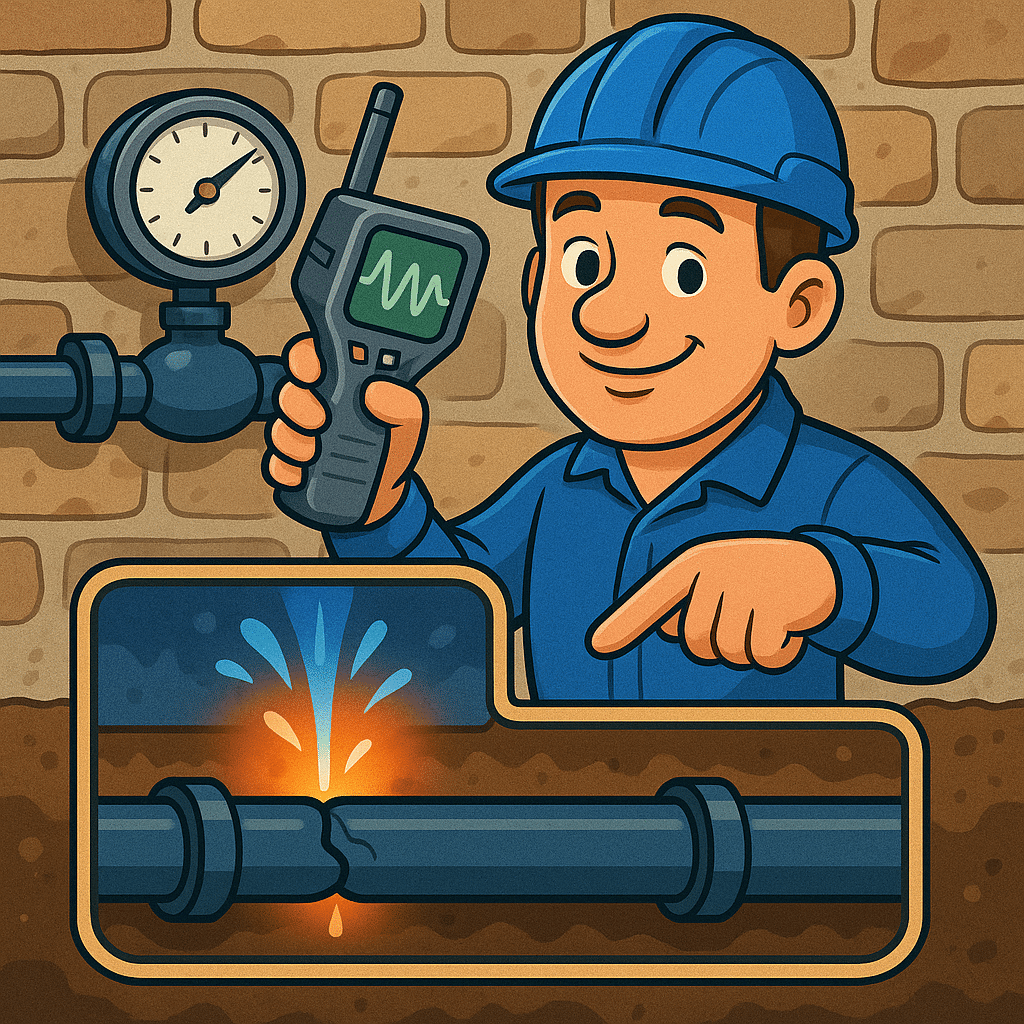
Moisture mapping follows the wet path through ceilings and walls, thermal imaging shows hidden pipe runs and wet routes behind plaster, and acoustic equipment picks up pressurised leaks. No ceilings come down on a guess.
Step 2: Identify the pipe, not just the puddle
The survey establishes which pipe is leaking and what it serves: one flat’s branch, the common stack, or the shared supply pipe. That single fact assigns the bill under the deeds or the Tenement Management Scheme.
Step 3: Put it in writing
The findings go into a report the factor, the owners and the insurers can all work from. One version of the facts, one repair, one properly split bill.
Frequently asked questions
The leak damaged my flat. Does that mean someone else pays my repairs?
Not automatically. The pipe repair falls to whoever owns the pipe: one owner for private pipework, the owners jointly for common pipes. Damage to your decoration and belongings normally goes through your own insurance as an escape of water claim, and your insurer may pursue recovery where another owner was at fault.
Our title deeds say nothing about pipes. What happens?
The Tenement Management Scheme in the Tenements (Scotland) Act 2004 fills the gap. Most scheme costs are split equally between the flats, switching to a floor-area split where the largest flat is more than one and a half times the size of the smallest. A majority of owners can decide to instruct the repair.
Can one owner block a common repair?
No. Under the Tenement Management Scheme, a majority decision of the owners is enough to instruct maintenance of common property, and the cost is then shared by everyone liable, including any owner who voted against or ignored the process. This is exactly the situation the 2004 Act was written for.
Who pays to find the leak, as opposed to fixing it?
Detection follows the same logic as the repair: if the leaking pipe turns out to be common, locating it is reasonably part of the shared job. In practice, trace and access cover on a buildings policy often pays for locating the leak and making good access, so check the relevant policy before owners split the cost.
Do these rules apply to modern blocks of flats too?
Broadly, yes. The Tenements (Scotland) Act 2004 applies to buildings divided horizontally into separate flats, which covers modern developments as well as Victorian closes. Newer deeds tend to be more thorough, so the deeds themselves usually answer the cost question before the default scheme rules are needed.
Related reading
- Water Leak From the Flat Above: Your Rights in Scotland
- Shared Supply Pipes in Scottish Flats and Terraces: Who’s Responsible?
- Who Is Responsible for Water Pipes in Scotland?
- Why Insurers Ask for a Leak Detection Report (and What’s in One)
MCR Leak Detection traces leaks through tenements and blocks across Glasgow, Edinburgh and the rest of Scotland.
Speak to MCR Leak Detection
Before a close can split a bill, it needs to know whose pipe is leaking. We answer that question non-destructively, Scotland-wide and 24/7, with a written report your factor, neighbours and insurers can all rely on.