
Topping The Manifold Up Every Week? Talk To Us
Warm water escaping under a floor does damage around the clock. We can have an engineer locating it today.
📞 Get A Free Quote: 07700 152 467How An Underfloor Heating Leak Announces Itself
A UFH leak hides under layers of covering, screed and insulation, which makes it one of the hardest faults in a house to see coming. Spot the warning signs early and the fix stays small; miss them and you drift towards widespread water damage and the cost of lifting whole floors. Knowing what to look for buys you time.
Wet systems mostly run for years without trouble, yet a rushed installation, corrosion, a nail from another trade or plain old age can start a leak. Finding those buried faults with the flooring intact is exactly what MCR Leak Detection does.
The Gauge Keeps Falling
Repeated top-ups at the manifold, or a gauge that never holds steady, mean water is getting out of one of the loops beneath the floor.
One Patch Never Warms
When most of the floor heats as normal but one area stays cold, circulation through that loop has been disrupted, and a leak is the usual reason.
Moisture Coming Up Through The Floor
Wetness at floor edges or working up through grout lines points to heating water escaping from the pipework below and finding its way to the surface.
Low-Pressure Lockouts On The Boiler
A modern boiler locks out once pressure falls too far. If low-pressure errors keep appearing on the display, the underfloor circuit deserves a close look.
Rooms Slow To Reach Temperature
A room that heats sluggishly, or never quite gets there, may have a zone running on reduced flow because water is leaking away.
The Floor Itself Is Telling You
Laminate warping, tiles lifting, carpet staining or boards buckling are late-stage signs of a long-running leak underneath, and they mean act now.
Important: No underfloor leak fixes itself. Warm water flowing constantly through the floor structure breaks down screed and insulation and invites mould, so the sums always favour early detection over an eventual full floor replacement.
Request A Free UFH Leak Detection Quote
Engineers across Scotland. One agreed price, nothing added later.
The Methods That Find UFH Leaks
UFH pipework is sealed into screed or buried under insulation, so there is no reaching it the way a plumber reaches a normal pipe. That is why this work needs dedicated kit and people who use it daily. Everything we do happens from above the floor, and the floor stays down while we do it.
No single instrument tells the whole story, so we layer several. Each one contributes a different piece of evidence, and combined they place the leak within a few centimetres, small enough for a genuinely targeted repair.
Tracer Gas Testing
For UFH this is the workhorse. The affected loop gets drained and charged with a harmless hydrogen and nitrogen blend, and detectors above the floor find where the gas escapes. The tracer gas method reads through screed, insulation and any covering, giving an exact position with nothing taken apart.
Most Accurate for UFHThermal Camera Survey
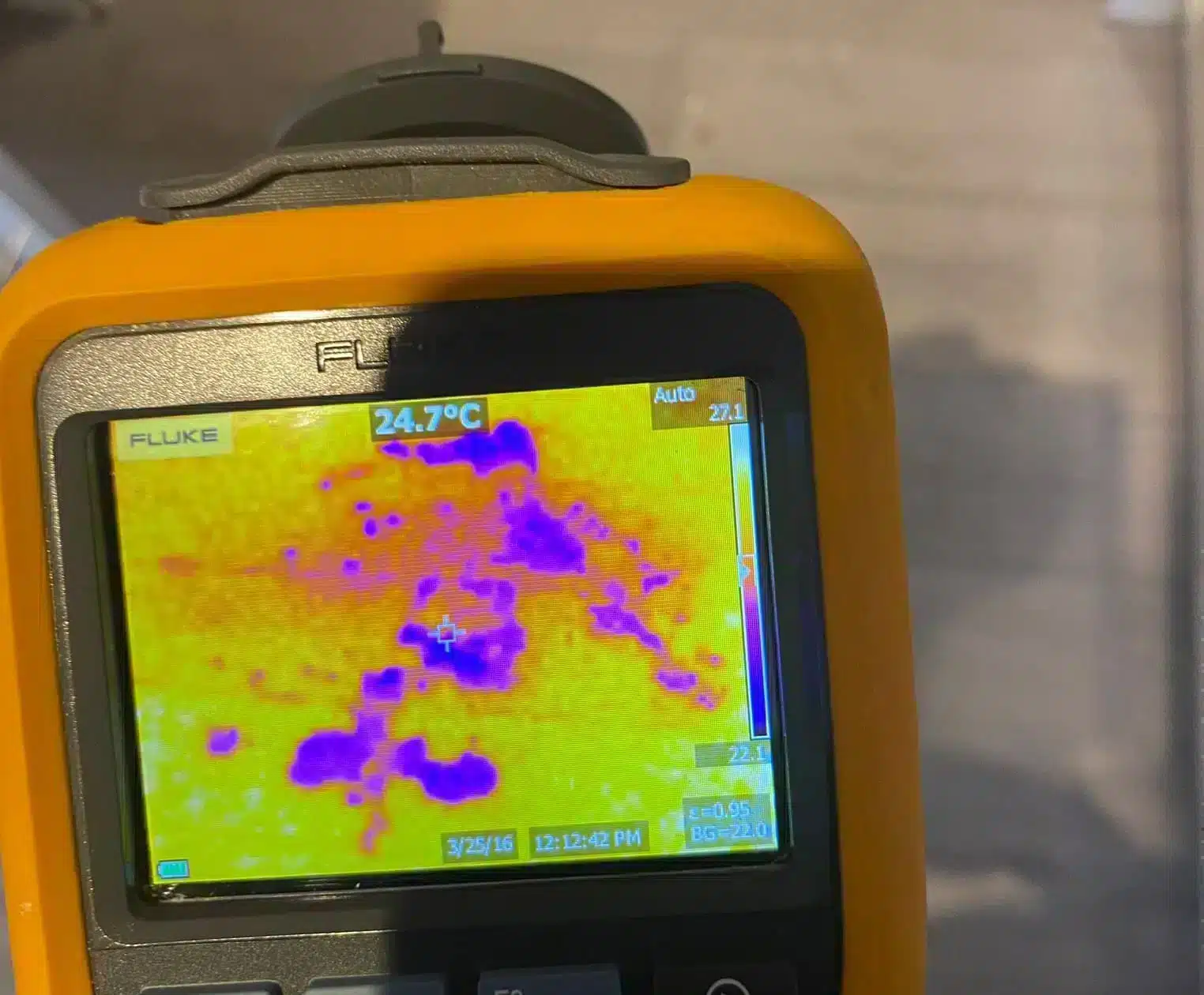
Our thermal imaging cameras draw the heat pattern of the whole floor on screen. Escaping hot water, blocked loops and trapped air each disturb that pattern in their own way, so we get instant visual evidence of trouble without touching anything.
Visual ConfirmationLoop-By-Loop Pressure Tests
At the manifold we shut off each loop in turn and pressure test it on its own. The circuit that bleeds pressure is the one hiding the leak, which shrinks the search area before the other instruments even come out of the van.
Loop IdentificationListening Equipment
Bigger leaks make noise, and our acoustic listening equipment hears it. The microphones register frequencies no human ear can, which is especially useful around manifold connections and the flow and return pipes.
Manifold SpecialistMoisture Meter Mapping
Meter readings across the floor chart how far the escaped water has travelled. That confirms the leak position, shows the true extent of the damage, and tells your insurer whether structural drying will be needed once the repair is done.
Damage AssessmentBorescope Checks
Where there is a way in, a flexible camera goes down to look at manifolds, connections and any reachable pipework directly. Seeing the fault with our own eyes firms up the diagnosis and shapes the repair plan.
Visual VerificationSand and cement screed, modern flowing screed or a retrofit system tucked under timber boards: the construction makes no difference to the outcome. Layered methods mean the leak gets found either way.
How A UFH Leak Survey Runs
The routine below was built around UFH systems specifically. It keeps disruption low, gets the location right first time, and spares you the trial-and-error repairs that make these jobs expensive.
Understand Your System First
We look over the manifold, go through any installation records you hold, and listen to the history of the symptoms. Zones, loop lengths and floor build-up all shape which detection route will work best on your system.
Test The Manifold And Each Zone
Connections, flow meters and actuators at the manifold get checked first. Then every loop is isolated and pressure tested one at a time until the leaking circuit gives itself away.
Map The Floor With The Camera
With the heating on, the thermal camera sweeps each floor and draws out the heat distribution. Cold spots and pooling water stand out, and the pipe layout itself becomes visible beneath the surface.
Pin It Down With Tracer Gas
The suspect loop is drained and filled with tracer gas, and the probe finds exactly where it surfaces. The spot gets marked for repair, and in most cases the access needed amounts to a tile or two, or one small square of flooring.
Show You The Evidence
Before anything else happens, you see the findings on our screens for yourself. The marked position and the readings behind it are shown and explained, so you know the diagnosis is solid before repair work starts.
Report And Repair Options
You get a written report covering the location, photographs, the technical readings and what we advise for the fix, in a format insurers accept. From there we can organise the repair ourselves or hand everything to your chosen contractor.
Put An End To The Pressure Loss
Underfloor heating leaks traced anywhere in Scotland, with the floor still down when we leave.
Why Put Your UFH Fault In Our Hands
UFH Faults We See Again And Again
Underfloor systems fail in their own particular ways, and over the years our team has traced every one of them in Scottish homes and businesses, from day-one installation defects through to plain wear and age.
Knowing where these systems tend to give out helps you spot trouble early and call for detection before the damage spreads far.
Weeping Manifold Connections
Thermal movement, corrosion and rushed fitting all loosen flow and return connections over time. We identify the culprit without pulling your manifold cabinet apart.
Pipes Damaged During Building Work
A careless moment during screeding, or a fixing driven in by a later trade, can pierce a heating pipe. New builds produce this fault more than anywhere else.
Hidden Joints Giving Out
A properly installed loop has no joints in the floor, but plenty of floors have them anyway, and eventually they fail. We find these buried connections so they can be repaired or bypassed.
Leaking Zone Valves And Actuators
Motorised valves and actuators can leak internally or at their unions. The thermal camera shows these faults up without the control gear being dismantled.
Fractures At Expansion Joints
In large floors, pipes that cross expansion joints get worked back and forth until they crack. We locate these stress points so the repair can use proper flexible connections.
Freeze Damage In Floor Voids
A poorly insulated void and a Scottish winter is a bad combination for pipework. We trace every frozen-and-split section along the run, not just the one currently leaking.
Large Commercial Installations
Multi-zone commercial underfloor heating with layered manifold arrangements is regular work for us, across offices, schools and retail units throughout Scotland.
Trouble In Retrofit Systems
When UFH gets added to an older property, the transition points between old and new are where leaks tend to start. Our methods handle any installation style and any floor build-up.
Traditional 16mm barrier pipe, multi-layer composite or ageing polybutylene: the pipe in your floor changes our technique, not the result. And once found, our trace and access service keeps the repair itself tidy and contained.
UFH Leak Detection Wherever You Are In Scotland
Our technicians take UFH surveys to every corner of Scotland, and they know the quirks of the building stock here, whether that means a new eco-home or a converted steading running a retrofit system.
Major Cities: Quick-response UFH engineers working across Edinburgh and Glasgow.
Central Scotland: Regular UFH survey work in Stirling, Falkirk, and West Lothian.
Arrange Your UFH Leak Survey
Get the pressure holding and the whole floor warming again
Get Your Underfloor Leak Located
A floor should never be replaced to fix one small leak. Precision detection marks the fault for a targeted repair and keeps thousands of pounds in your pocket.
Why UFH Leaks Reward Fast Action
An underfloor leak is nothing like a dripping pipe under the sink. It sits sealed beneath flooring, screed and insulation where no one can see or reach it, and while you wait, warm water keeps working away at the floor structure from the inside.
Left alone, the costs climb steeply. Occasional top-ups turn into structural damage, mould takes hold, and in the worst cases a whole floor has to come out at a cost running into tens of thousands. In a Scottish climate a sound, efficient heating system also protects the building itself and the health of the people in it.
A well-installed wet system should run for decades without attention, so when symptoms appear they point to a real fault that will not clear on its own. Proper detection removes the miserable choice between tolerating a leak and tearing out a floor.
The kit carried by MCR Leak Detection was chosen for exactly these jobs. Tracer gas locates faults through any floor construction, and the thermal camera reads the whole system in minutes without disturbing a thing.
Save the floor, keep the warmth. Call our UFH team today and have the leak found without a single board lifted in the search.