

Check the visible parts first: radiator valves, compression joints and the boiler’s external discharge pipe. Dry each joint and press dry tissue against it. If nothing shows and the pressure keeps falling, the leak is almost certainly on a hidden pipe run, and thermal imaging or tracer gas will locate it without ripping up floors.
How to Find a Leak in a Central Heating System
A sealed central heating system holds the same water round and round. So when the boiler pressure keeps sliding and you find yourself topping up every few days, that water is going somewhere. Sometimes the escape route is obvious, a weeping radiator valve or a drip under the boiler. Often it is a pinhole on a pipe buried under a floor, and the first visible clue arrives months later as a stain or a smell.
This guide walks through the same order of elimination our engineers use across Scotland: cheap and visible checks first, hidden pipework last. Work through it before you let anyone lift a floorboard on a hunch.
What’s in this guide
First, confirm it really is a leak
Falling pressure has more than one cause, so start with a simple test. Top the system up to its normal cold pressure (most sit between 1 and 1.5 bar when cold, and your boiler manual gives the exact figure). Then note the gauge reading at the same time each morning for a week, before the heating fires. A steady downward slide points to water escaping. We cover the full list of causes in our guide to why boilers lose pressure.
Two escape routes are easy to miss because they dump water outside the house. The pressure relief valve discharges through a small copper pipe on an outside wall, so check whether that pipe is damp or has left a tide mark on the wall below. An automatic air vent can also let water vapour away slowly. Neither is a pipe leak, but both empty your system just the same.
Step 1: check every radiator and valve
Radiator valves are the most common weep point in the whole system, and the fix is often a quarter turn on a gland nut. Go room to room with a torch and a roll of tissue. Dry every valve, then press clean tissue against each spindle, each compression nut and each bleed plug. The tissue shows a weep your fingers cannot feel.
- Valve bodies and gland nutsThermostatic heads hide the spindle, so pop the head off and check underneath. A damp spindle means the gland packing has dried out or worn.
- Inhibitor stainingHeating water carries black sludge and inhibitor chemicals, so it rarely dries clean. Rusty, orange or green crusty tide marks on a joint mean water has been escaping there, even if it is dry today.
- Skirting and carpetFeel the carpet under each radiator end. A slow drip wicks into underlay long before it puddles.
Step 2: check the boiler itself
Put a sheet of newspaper or kitchen roll under the boiler overnight. A drip from the flow and return connections, the pump or the diverter valve will mark it by morning. Look up at the bottom of the casing too, since a slow internal weep often shows as limescale streaks or rust around the case seams.
One firm warning here. Do not remove the boiler casing. Anything behind the case is a job for a Gas Safe registered engineer, and an internal boiler leak usually means a part has failed rather than a pipe. If the drip is coming from the boiler itself, book a boiler engineer. If the boiler checks out dry, keep reading, because the rest of the system is our territory.
Step 3: follow the pipework you can see
Now trace every accessible pipe run: airing cupboard, under the kitchen units, behind bath panels, along the loft. Run a dry hand along each pipe and check every joint with tissue, exactly as you did on the radiators. Pay attention to compression fittings, which loosen with years of heating and cooling cycles, and to any joint that has been repaired before.
In lofts and under suspended floors, look at the timber rather than the pipe. Water stains, dark patches or white salt deposits on joists sit directly below a joint that has been weeping for a while.
The signs of a leak on a hidden pipe run
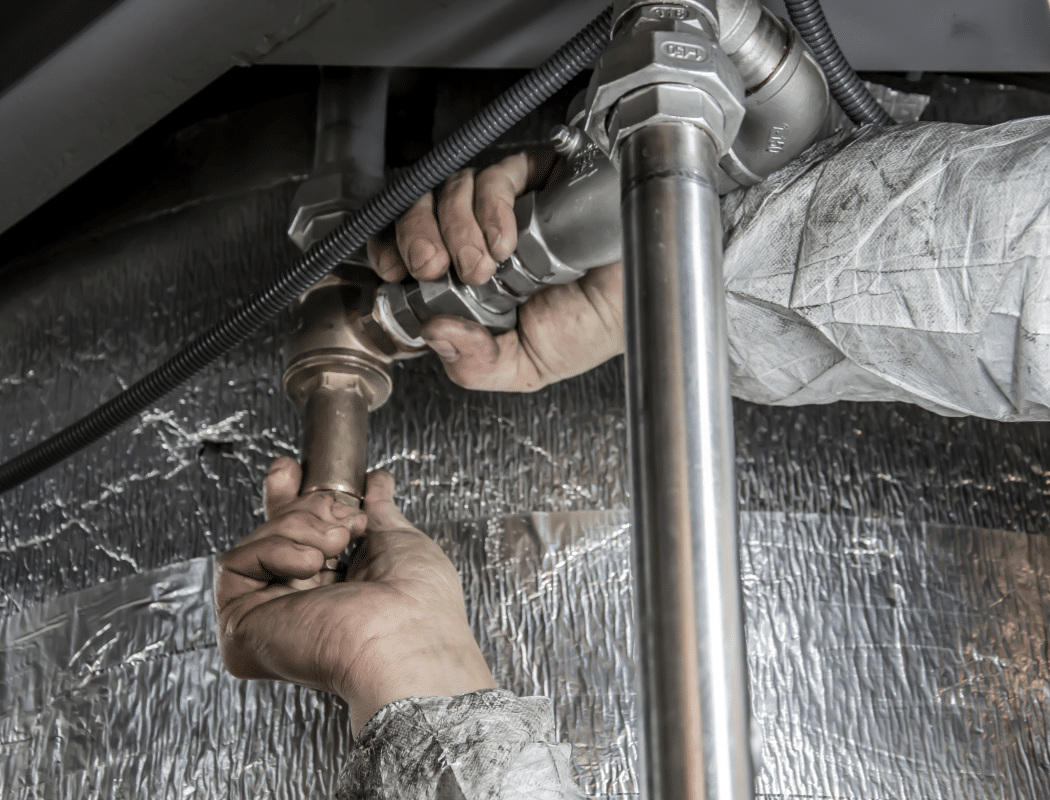
If every visible joint is dry and the pressure still falls, the leak is on a concealed run: under floors, chased into walls or buried in screed. Hot water gives itself away, though. Watch for these signs:
- A warm patch on the floorA spot that feels warmer than the surrounding floor, even with the heating off for an hour, often sits right over a leaking flow pipe.
- Lifting or cupping boardsTimber swells across the grain when it takes on moisture. Laminate lifts at the joints.
- Stains on the ceiling belowIn two-storey homes, a first-floor heating leak usually announces itself on the ceiling underneath, though rarely directly below the pipe.
- A musty smellPersistent damp under a floor smells earthy long before anything is visible.
We cover this scenario in depth in our guide to a central heating pipe leaking under the floor.
If you’d rather not lift floorboards on a hunch, call us on 07700 152 467 and we’ll pinpoint the leak first. It is a far cheaper conversation than a relaid floor.
How professionals find a leak in a central heating system
Professional detection is a process of narrowing down, not guesswork. Here is how a typical survey runs on a heating circuit:
1. Isolate and pressure test
We split the system into sections, isolating the boiler, then individual circuits or floors, and watch which section loses pressure. That tells us which part of the house hides the leak before any kit comes out of the van.
2. Thermal imaging
With the heating warm, a thermal camera sees the heat plume spreading from a leaking hot pipe through floor coverings and plaster. It maps the pipe run and flags the anomaly. Our article on thermal imaging leak detection explains what the camera can and cannot see.
3. Tracer gas and acoustics
For buried or plastic pipework we drain the circuit and introduce a safe hydrogen and nitrogen trace gas. The gas escapes at the leak, rises through the floor and registers on a sniffer probe above. Read more in our guide to tracer gas leak detection.
4. Mark, confirm, open up once
The point of all this is a single, small access hole directly over the leak, instead of a trail of exploratory holes across the house.
Microbore pipework: a special case
Plenty of Scottish homes built or replumbed from the 1970s to the 1990s run on microbore, copper pipe of just 8 or 10 millimetres. It was quick to install and easy to hide, which is exactly the problem now. Microbore kinks easily, blocks with sludge, and is often buried in screed or threaded through joists with no access at all.
Pinholes on microbore are quiet leaks. The escape is tiny, so acoustic methods struggle, and the pipe runs are rarely where you would expect. On these systems tracer gas earns its keep, because the gas finds its way up through the floor no matter how small the hole. If your home has microbore and the pressure keeps dropping, skip the exploratory carpentry and get the circuit tested properly.
What it costs and where insurance fits
Two pieces of good news before you panic about the bill. First, professional detection is priced to avoid the expensive part, which is tearing rooms apart looking in the wrong place. Our leak detection cost guide sets out honest market rates from named UK sources.
Second, if the leak has caused damage, your buildings insurance probably helps with the finding. MoneySuperMarket, citing Defaqto, reports that 94% of buildings policies include trace and access cover, typically capped between £5,000 and £10,000. That cover pays for locating the leak and making good the access, though not the pipe repair itself.
Before you call anyone, note these down
- How fast the pressure falls (bar per day, from your gauge diary)
- Which rooms have warm spots, stains or smells
- Whether the discharge pipe outside is wet
- The age of the system and any past repairs
Frequently asked questions
How much pressure loss is normal for a boiler?
A healthy sealed system holds its cold pressure for months. A tiny seasonal drift is nothing to worry about, but needing a top-up every week or two is not normal. Track the gauge at the same time each morning for a week; a steady fall means water is leaving the system.
Will the leak be where the damp patch is?
Usually not. Water tracks along pipes, joists and the underside of floors before it surfaces, so the visible stain can sit a surprising distance from the actual hole. That is why we trace the leak with instruments before recommending anyone opens up a floor or ceiling.
Can I just use a central heating leak sealer?
A leak sealer is a gamble. On a tiny weep it sometimes buys time, but it can clog heat exchangers and valves, and it masks a fault that continues damaging the building. We would rather you found the leak and fixed it properly, especially if the water is going under a floor.
Does home insurance cover a central heating leak?
Many buildings policies cover the damage a leak causes and include trace and access cover for locating it, with MoneySuperMarket reporting 94% of policies carry it. The repair of the failed pipe or valve itself is normally your own cost. Check your policy wording before committing to work.
How long does it take to find a central heating leak?
It depends on the size of the system and how deeply the pipework is buried. Straightforward faults show up quickly once the system is sectioned and tested, while buried microbore circuits take longer. Having your pressure notes and boiler history ready always speeds the survey up.
Speak to MCR Leak Detection
If your heating system is losing water and the tissue test has drawn a blank, our engineers pinpoint hidden heating leaks non-destructively, anywhere in Scotland, 24/7. One small access hole beats a wrecked floor.
Related reading
- Boiler Pressure Dropping Overnight: What It Usually Means
- Central Heating Pipe Leaking Under the Floor: Signs and What to Do
- How to Repressurise a Boiler (and When You Shouldn’t)
- Leaking Radiator Valve? Causes, Quick Fixes and When to Worry
Or learn more about our water leak detection across Scotland.