

The most expensive leak detection myths: the stain sits below the leak, leak sealer fixes it, the water bill would show it, finding a leak means digging, and insurance covers everything. Each one leads to wrong repairs, wrecked floors or refused claims. Water travels, most Scottish homes have no meter, and modern detection is non-destructive.
7 Leak Detection Myths That Cost Homeowners Money
Most of the expensive leak stories we attend did not start with the leak. They started with a belief about leaks that turned out to be wrong: a ceiling opened in the wrong place, a bottle of sealer poured into a heating system, a claim refused for slow damage. The water did some of the harm; the myth did the rest.
Here are the seven we meet most often across Scotland, why each one is wrong, and what the evidence says instead. Each myth links to a full guide if you want the detail.
In this guide
Myth 1: the stain on the ceiling sits directly below the leak
This is the myth that opens the most unnecessary holes. Water obeys gravity, but on the way down it follows whatever it touches first: the top of a joist, the underside of a pipe, the back of plasterboard. It can travel metres sideways before it finds a place to show itself, so the stain marks where the water arrived, not where it escaped.
Cutting the ceiling at the stain often reveals dry timber and a longer search. Tracking the true source is a process of tracing water travel with moisture meters and thermal imaging, working uphill from the stain. Our guide to finding a leak in a wall or ceiling walks through it properly.
Myth 2: a bottle of leak sealer will fix it
Leak sealer is a gamble, and we say that as people with no stake in selling it. Sealing products circulate through the whole heating system to reach one tiny weep, and everything else gets coated on the way: heat exchanger passages, valve seats, air vents. Some competitors in our own industry publish warnings against the stuff, which tells you something.
At best, a sealer buys time on a pinhole weep. At worst it masks a leak that keeps damaging the building while the boiler picks up a new fault. The honest sequence is to find the leak, then fix that one joint or section of pipe. Our full verdict is in central heating leak sealer: does it actually work?
Myth 3: if I had a leak, my water bill would show it
Sound advice in England. Mostly useless in Scotland. Most Scottish households pay for water through council tax, with no meter on the supply, so a leak changes the bill by exactly nothing. A supply pipe can pass thousands of litres a week and every invoice arrives looking normal. The same logic kills the related belief that a leak allowance will soften the blow; the household version does not apply in unmetered Scotland, as we explain in our guide to leak allowances in Scotland.
Without a meter you need different tests: the stop valve isolation check, listening at the stopcock at night, and the boiler pressure diary. All of them are in our guide to checking for a leak without a water meter.
Myth 4: finding a hidden leak means digging up floors
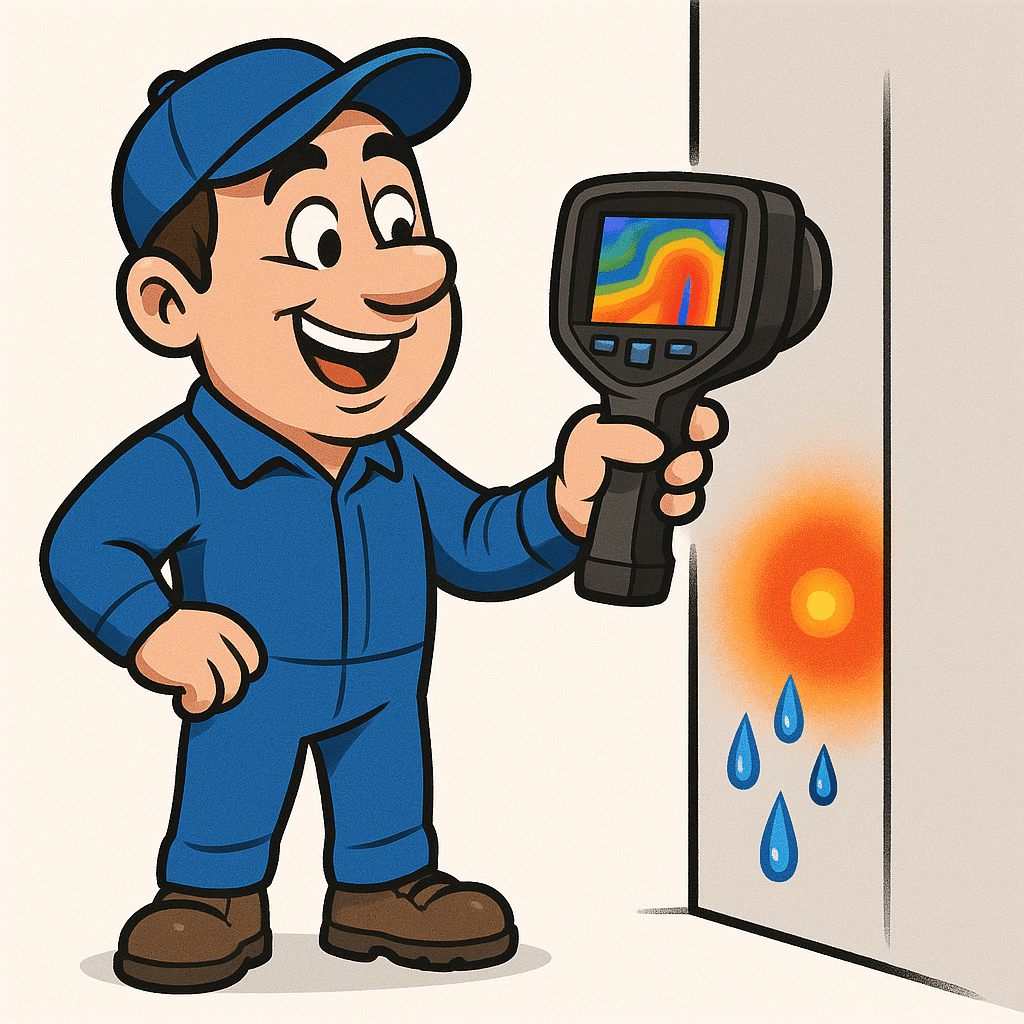
A generation ago, finding a buried leak did mean exploratory demolition: lift boards, break screed, dig trenches, repeat until wet. The tools have moved on. Acoustic microphones hear pressurised water escaping, thermal cameras see the temperature signature of a leak through flooring, and tracer gas rises through concrete to a sniffer probe above.
Modern practice pinpoints the leak first, so one small opening lands on the right spot. That is the whole case for non-destructive leak detection, and it is why detection usually costs less than the redecorating it prevents.
Myth 5: home insurance covers everything about a leak
Escape of water is one of the most commonly claimed perils, and also one of the most misunderstood. Policies generally cover the sudden damage a leak causes. They generally exclude the repair of the failed pipe itself, wear and tear, and damage that happened gradually while a slow leak went unnoticed. That last exclusion catches the most people, because slow leaks are precisely the ones nobody notices.
The other half of the picture is trace and access cover, which pays for finding the leak and making good the access. According to MoneySuperMarket, citing Defaqto, 94 per cent of buildings policies include it, typically capped between £5,000 and £10,000. Read our guides to what home insurance covers on water leaks and slow leaks and insurance before you assume anything.
Myth 6: no damp patch means no leak
Plenty of leaks never produce a damp patch at all. Water disappearing into free-draining ground, a warm heating pipe weeping under a solid floor, a slow escape inside a boxed-in void: all can run for months invisibly. The building usually mentions it another way first.
- Boiler pressure that keeps fallingA sealed system losing pressure is losing water somewhere, full stop.
- Sounds of water when everything is offA hiss or tick at the stopcock in a silent house.
- A musty smell with no visible causeOften the earliest signal of concealed moisture.
- Warm spots on floors, mould in odd corners, dropping pressure at tapsEach one is a data point, not a coincidence.
We keep the full symptom list in 12 signs of a hidden water leak. If two or more sound familiar, call us on 07700 152 467 before the patch finally appears, because by then the damage bill has already been running for months.
Myth 7: Scottish Water will fix any leak on my property
Scottish Water is responsible for the water main, the communication pipe up to your boundary and the boundary stopcock. From the boundary to your kitchen tap, the supply pipe and everything inside belongs to the owner, including the stretch under your garden, driveway or floor. Under the Water (Scotland) Act, owners are legally obliged to repair leaks on their own supply pipe, and Scottish Water can serve notice and ultimately charge for a repair it carries out.
So the realistic position is the reverse of the myth: on most private leaks, Scottish Water is the body that can require you to fix it, not the one that fixes it for you. The full boundary map, including shared pipes in flats and terraces, is in our guide to who is responsible for water pipes in Scotland.
Speak to MCR Leak Detection
Myths open the wrong holes. Evidence opens the right one. We locate hidden leaks non-destructively across Scotland, 24/7, and hand you a report your plumber and insurer can act on.
Leak detection myths: frequently asked questions
What is the most expensive leak myth?
In our experience, the ceiling stain myth. Opening a ceiling or wall at the stain misses the source more often than it finds it, because water travels along joists and pipes before showing. Homeowners then pay for the wrong hole, the real search and the repair of both.
Does leak sealer ever make sense?
On a tiny weep in an ageing system where the owner accepts the risk, a sealer sometimes buys time. It remains a gamble: the product circulates everywhere, can affect heat exchangers and valves, and hides a fault that continues to develop. Locating and repairing the leak is the dependable route.
How do professionals find leaks without digging?
By combining methods: acoustic listening equipment hears escaping water, thermal imaging shows temperature anomalies through surfaces, moisture meters map the wet area, and tracer gas rises from a buried leak through floors or ground to a detector. Cross-referencing them pinpoints the leak before anything is opened.
Is it true a leak will not affect my water bill in Scotland?
For most households, yes. Scottish homes are generally unmetered and pay through council tax, so no leak changes the bill. The cost arrives as property damage instead. Metered businesses are the exception, and they can claim a burst allowance for water lost to a repaired hidden leak.
Will my insurer pay for leak detection?
Usually, if your buildings policy includes trace and access cover, which 94 per cent do according to MoneySuperMarket citing Defaqto. It pays for locating the leak and making good the access, within a limit typically between five and ten thousand pounds. The pipe repair itself normally sits outside the cover.
Related reading
- How to find a water leak: 10 ways to track it down
- DIY leak detection vs calling a professional
- Non-destructive leak detection: what it means for your home
- How much does leak detection cost?
Or learn more about our water leak detection service across Scotland.