

A slab leak is a pipe failing inside or beneath a solid concrete floor. Engineers find it without breaking out the slab by combining thermal imaging, acoustic listening and tracer gas, then mark a single repair point. Warning signs include a boiler that keeps losing pressure, warm patches underfoot and damp creeping up skirtings.
Leaks Under Concrete Floors: How Slab Leak Detection Works
Suspended timber floors give you a fighting chance with a leak: lift a board, shine a torch, and there is the pipe. A solid concrete floor gives you nothing. The pipes run through or beneath the slab, sealed in by screed, insulation and whatever floor finish sits on top, and the first sign of trouble is usually indirect, a pressure gauge that keeps falling or a floor that feels oddly warm.
Slab leak detection is the discipline of finding that failure without turning the ground floor into a demolition site. Here is how it works, what the process looks like on the day, and the honest facts about repair options once the leak is marked.
What’s in this guide
What a slab leak actually is
Solid ground floors dominate Scottish housing built from the mid-20th century on, and plenty of older stone properties have had concrete floors poured during renovations. In these homes, heating pipes commonly run through the screed layer, and the incoming water supply often enters through or under the slab. Underfloor heating goes further still, with its whole pipe circuit buried in the floor.
A slab leak is any of those pipes failing where you cannot see it: a corroded copper pinhole, a joint pulled by decades of thermal movement, a pipe nicked during construction that finally lets go, or a frost-damaged supply beneath the floor. Heating pipes fail more often than cold mains here, because they expand and contract with every heating cycle and spend their lives warm, which accelerates corrosion.
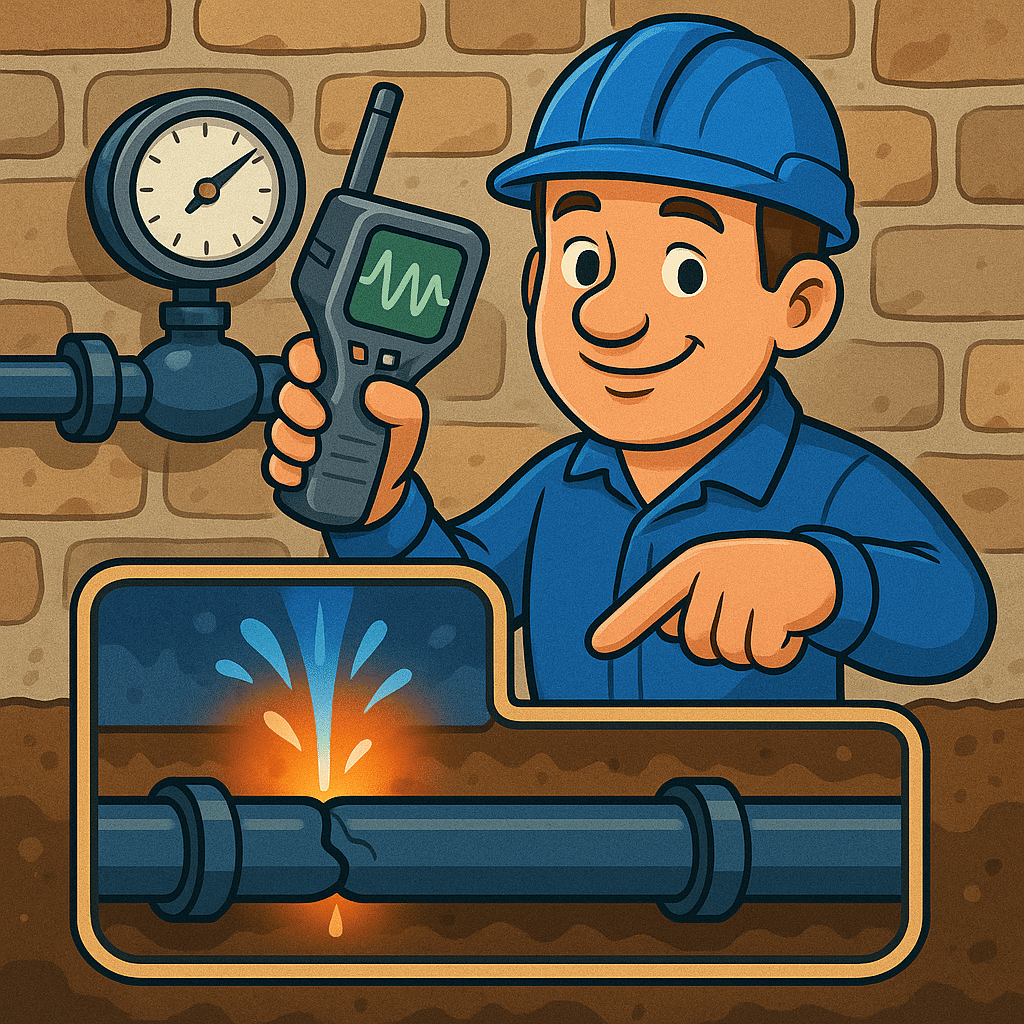
What makes slab leaks expensive is not the pipe. It is the time they run undetected. Water spreading under a slab has nowhere obvious to surface, so it soaks the ground beneath the floor, wicks up into walls and quietly ruins floor finishes from below.
By the time laminate lifts or skirtings stain, the leak may have been running for months. That is why the early, indirect signs deserve attention, especially a heating system that will not hold pressure.
The warning signs of a leak under a concrete floor
- Boiler pressure that keeps droppingOn a sealed heating system, repeated top-ups mean water is escaping somewhere. If every visible radiator and joint is dry, the buried pipework is the prime suspect. Our guide to boiler pressure loss walks through the elimination.
- A warm patch on the floorA leaking hot pipe heats the slab above it. A spot that feels warmer than the rest of the floor in bare feet, or that pets keep lying on, is a classic marker.
- Damp rising at skirtings and wall basesWater trapped under a slab migrates sideways and climbs into the wall fabric, showing as damp or salty staining just above floor level.
- Lifting, cupping or staining floor finishesVinyl bubbles, laminate swells and tiles debond when moisture comes up from below.
- A musty smell with no visible causePersistent damp odour at ground floor level often arrives before anything visible does.
- The sound of running waterWith everything off, a faint hiss at floor level or on pipework is worth taking seriously.
None of these alone proves a slab leak, and our article on telling if you have a leak under the floor covers the checks you can run yourself before calling anyone.
Why concrete makes leaks hard to find
Concrete hides evidence in three ways. It carries sound differently from soil, so a leak can be audible metres from its true position along the slab. It spreads moisture broadly, so damp readings at the surface map poorly onto the leak point below. And it blocks sight completely; there is no equivalent of lifting a floorboard for a look.
Guesswork is therefore brutally expensive. Breaking out concrete on a hunch means a breaker, dust sheets through the house, and a hole that may reveal nothing but a dry pipe. Miss twice and you have wrecked a floor without finding the water. This is the single strongest argument for measuring before anyone swings a breaker, the whole case for non-destructive leak detection in one room.
How slab leak detection works, step by step
1. Narrow it to a system
First question: which pipework is losing water? Isolating circuits and watching pressure behaviour separates a heating leak from a mains supply leak. On heating systems, a pressure test on the sealed circuit confirms the loss rate; on mains, a stop tap test does the same job.
2. Map the pipe runs
Pipe and cable locators trace where the pipework actually runs through the slab, which in renovated Scottish homes is regularly nowhere near where the drawings, or the owner, believed. The search area shrinks from a whole floor to a line.
3. Scan with thermal imaging
With the heating running, a thermal camera reads the heat signature of warm pipes through the floor surface. A leak shows as a bloom, a spreading warm patch rather than the crisp line of a healthy pipe. Our guide to thermal imaging leak detection explains what the camera can and cannot see.
4. Listen through the slab
Ground microphones pick up the hiss of pressurised water escaping, and hard concrete actually transmits that sound well. Comparing loudness along the traced pipe route brackets the leak position.
5. Confirm with tracer gas where needed
For quiet leaks, plastic pipes and underfloor heating loops, the pipe is drained and charged with a safe hydrogen and nitrogen mix. The gas escapes at the failure, rises through the slab, and a surface probe finds it. Tracer gas testing is often the decisive method on solid floors.
6. Mark the spot and report
The findings converge on a marked repair point, typically a small area of floor rather than a trench, and the survey is written up with photos and readings, which matters later for insurance.
If your boiler needs topping up every few days and nobody can find the water, call us on 07700 152 467 before anyone starts breaking concrete on a guess.
Repairing a slab leak: breaking out vs re-routing
Once the leak is marked, there are two honest routes, and the right one depends on the pipe’s condition and position.
Break out and repair
- Fixes the pipe where it lies, keeping the original layout
- A precise location keeps the excavation to one small patch of slab
- Usually the cheaper option when the leak is shallow and accessible
- Makes sense when the rest of the pipework is in good condition
Re-route above the slab
- Abandons the buried section and runs new pipe through walls, ceilings or boxing
- No breaking out, less dust and disruption in the living space
- The better call when pipework is corroding generally, since the next pinhole is coming
- Underfloor heating loops cannot be re-routed; they need a precise repair at the leak point
A word on expectations: detection dramatically shrinks the repair, but a repair still has to happen, and a floor finish over the repair point will need making good. Anyone promising a slab leak fixed with no disturbance at all is overselling. The realistic promise is one small, correct hole instead of several wrong ones.
Insurance: where trace and access earns its keep
Slab leaks are exactly the scenario trace and access cover was written for. That part of a buildings policy pays for locating the leak and making good the access, though not the pipe repair itself, and it is widespread: MoneySuperMarket, citing Defaqto, reports 94% of buildings policies include it, with typical limits between £5,000 and £10,000.
A professional detection report documents where the leak was, how it was found and what access was required, which is the evidence an insurer wants to see. Our guides to trace and access cover and making a water leak insurance claim cover the claim process in detail.
Frequently asked questions
How do I know if I have a leak under my concrete floor?
The strongest signs are a sealed heating system that keeps losing pressure with no visible leak, a warm patch on the floor, damp appearing at skirting level and a musty smell downstairs. Any one of these on a solid floor justifies a proper survey before opening anything up.
Can a leak under a slab be found without breaking the floor?
Yes. Thermal imaging, acoustic listening and tracer gas all read the leak from the surface, and together they typically narrow it to a small marked point. The floor is only opened once, at the repair spot, rather than being broken out in search of the pipe.
What usually causes slab leaks?
Corrosion pinholes in copper heating pipes are the most common failure, driven by decades of heating cycles. Joints pulled apart by thermal movement, construction damage that fails years later and frost damage on supply pipes under floors make up most of the rest.
Is it better to repair a slab leak or re-route the pipe?
Repair at the marked point when the pipework is generally sound and the leak is accessible. Re-route above the slab when the buried pipe is corroding along its length, because the next pinhole is only a matter of time. Underfloor heating loops are the exception: they need repairing in place.
Does insurance cover a leak under a concrete floor?
Usually in two parts. Trace and access cover pays for finding the leak and making good the access, and escape of water cover pays for the resulting damage. The pipe repair itself is normally excluded. Most buildings policies include trace and access, but check your limit and excess.
Speak to MCR Leak Detection
A leak under a concrete floor does not have to mean a broken-out ground floor. We pinpoint slab leaks non-destructively with thermal imaging, acoustics and tracer gas, anywhere in Scotland, 24/7.
Related reading
- Water Leak Under the Floor? How to Tell Without Lifting It
- Tracer Gas Leak Detection: How It Works and When It’s Used
- How Thermal Imaging Finds Hidden Water Leaks
- Central Heating Pipe Leaking Under the Floor: Signs and What to Do
Or learn more about our professional leak detection across Scotland.