
A drip from the spout usually means a worn washer; a leak from around the handle means the gland packing has gone. Both are cheap fixes. Before winter, shut the inside isolation valve and drain the tap, because frost-split taps and pipes cause a large share of Scottish burst callouts.
Outside Tap Leaking? Fixes and Frost Protection
The garden tap is the most neglected fitting on the house. It lives outside in the weather, gets wrenched on and off with wet hands, and nobody looks at it between October and April. So when it starts dripping, most people ignore it, and that is usually fine, right up until the winter it freezes or the drip turns out to be coming from inside the wall.
Here is how to work out where an outside tap is leaking from, the two fixes that cure nearly all of them, how to protect the tap before frost arrives, and the warning signs that the problem is bigger than the tap.
What’s in this guide
Where is the outside tap leaking from?
Watch the tap for a minute with the water on, then off. The location of the escape tells you nearly everything.
| Where the water appears | Likely cause | Typical fix |
|---|---|---|
| Dripping from the spout when off | Worn tap washer | New washer, minutes of work |
| Weeping around the handle spindle when running | Failed gland packing or O-ring | Tighten gland nut or repack |
| Leaking at the joint where the tap meets the wall plate | Loose connection or failed thread seal | Remake the joint with fresh PTFE tape |
| Spraying from the tap body itself | Frost split in the casting | Replace the tap |
| Damp on the wall, but the tap looks dry | Leak on the supply pipe behind or inside the wall | Trace the pipe before opening anything up |
The first four are plumbing jobs anyone competent with a spanner can attempt. The last one belongs in a different category, and we come back to it further down.
Drip from the spout: replacing the washer
An outside tap is nearly always a simple bib tap, the same basic mechanism taps have used for a century. A rubber washer presses down on a brass seat to close the flow, and every turn of the handle grinds it a little flatter. When the washer hardens or wears, the seal fails and the spout drips.
1. Isolate the tap
Most outside taps have an isolation valve on the pipe inside the house, usually under the kitchen sink where the branch tees off. Turn its screw slot a quarter turn so it sits across the pipe. No isolation valve? Shut the main stopcock instead; our guide to finding your stopcock helps if you have never used it.
2. Open the tap and let it empty
Run the tap until nothing more comes out. This confirms the isolation worked and drains the branch pipe.
3. Remove the headgear
Undo the headgear nut below the handle with an adjustable spanner, holding the tap body steady with a second wrench so you do not strain the pipework behind the wall. Lift the mechanism out.
4. Swap the washer and rebuild
The washer sits on the base of the mechanism, held by a small nut or pushed onto a stud. Fit the matching replacement, reassemble, restore the water and test. If the drip continues, the brass seat itself may be scored, and at that point a whole new tap is cheaper than fighting it.
Leak around the handle: the gland
Water creeping out around the spindle while the tap runs is a gland leak. The gland is the packing that seals the rotating spindle, and it dries and shrinks over the years, especially on a fitting that bakes in summer and freezes in winter.
First try gently tightening the small gland nut directly under the handle, a quarter turn at a time. If the weep continues, the packing needs replacing: isolate the tap, remove the handle and gland nut, pick out the old packing and wind in new PTFE-based packing string. On a cheap tap, honesty says replace the whole thing, since a new bib tap costs little more than the afternoon you would spend nursing an old one.
The check valve, and why some taps get stiff
Outside taps installed in recent decades include a double check valve, either built into the tap or fitted on the pipe behind it. Its job is to stop anything siphoning backwards from a hosepipe into your drinking water. Check valves matter here for one practical reason: a trapped section of pipe between a closed tap and a check valve has nowhere to relieve pressure when it freezes, which makes proper winter draining even more important.
A tap that has become stiff or will not shut fully is telling you the mechanism is on its way out. Do not lean on it with a wrench; over-tightening chews the washer seat and can crack the body. Replace the headgear or the tap.
Frost protection: the job that saves the callout
Scotland gives outside taps a hard life. The tap and its branch pipe stick out of the heated fabric of the house, and in a sharp frost the water inside them freezes solid. Ice expands, and the split it forces open stays hidden until the thaw, when water starts running down the inside of the wall or across the kitchen floor. Scottish Water’s Protect your Pipes campaign puts outside taps on its checklist every winter for exactly this reason.
The five-minute autumn routine
- Shut the isolation valve on the inside branch pipe
- Open the outside tap fully and leave it open so the trapped water drains and any ice has room to expand
- Disconnect hoses; a connected hose holds water right up against the tap and defeats the draining
- Fit an insulated tap cover over the tap body
- Lag any exposed run of the branch pipe outside or in unheated spaces
Do it when the clocks change and reverse it in spring. Our guides to protecting pipes in a Scottish winter and what to do about frozen pipes cover the rest of the house.
When a leaking outside tap hides a bigger problem
Most outside tap leaks are exactly what they look like. A few are not, and these are the signs worth taking seriously.
Damp wall, dry tap. If the brickwork around the tap stays wet but the tap itself never drips, the leak is likely on the pipe where it passes through the wall, often at a joint you cannot see. Fixing the tap changes nothing because the tap was never the problem.
The drip that returns after every repair. New washer, new gland, new tap, and still water appears. That pattern points to a fault on the supply side, not the fitting.
Wet ground that never dries. A soggy patch near the tap or along the outside wall in dry weather suggests the underground supply pipe is leaking, and the tap is just the nearest suspect. Our article on wet patches in the garden or driveway explains how to read the ground.
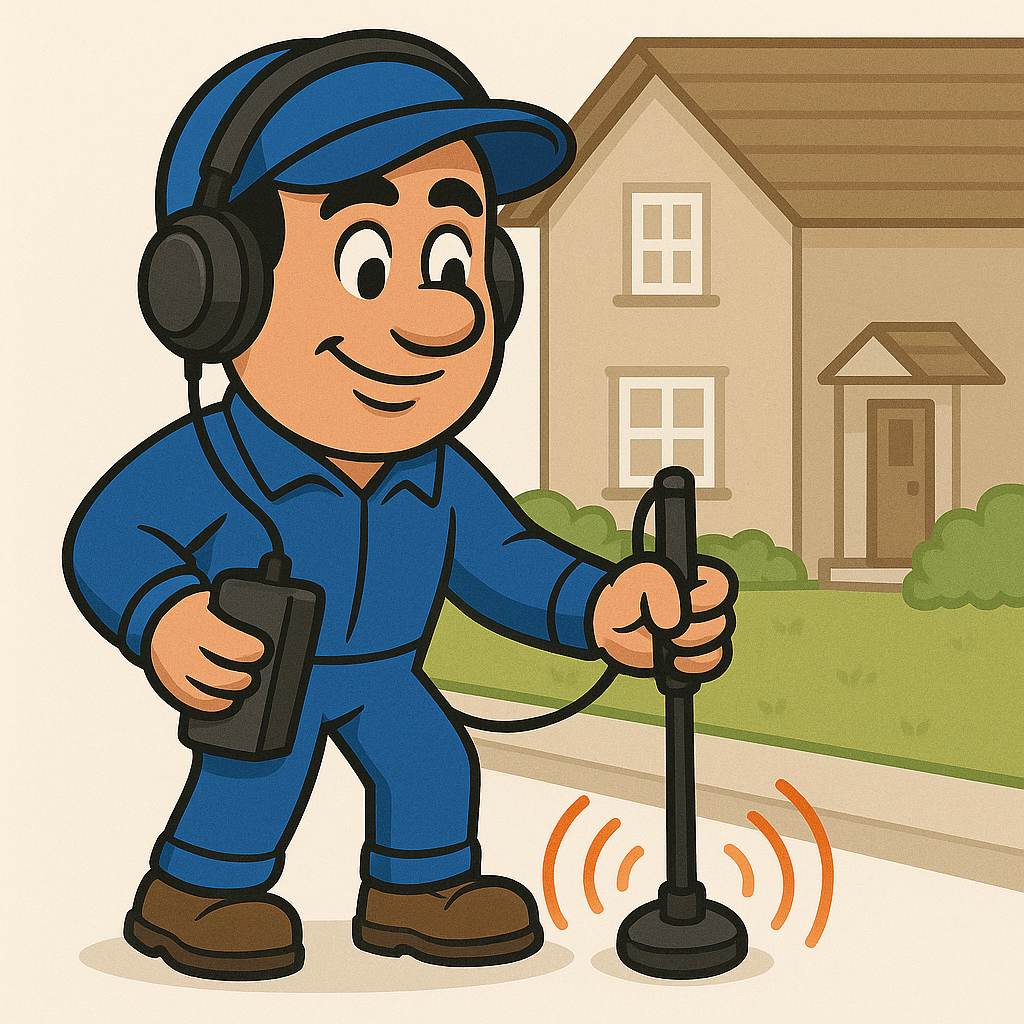
In these cases the wrong move is exploratory demolition, pulling off render or digging at random to chase the water. The right move is to locate the leak first. We do that non-destructively with listening equipment, thermal imaging and tracer gas, marking the leak point before anyone opens anything; our guide to acoustic leak detection shows how the listening side works. If a damp patch near your outside tap will not dry up, call us on 07700 152 467 before you start pulling the wall apart.
Frequently asked questions
Why is my outside tap dripping when it is turned off?
The washer inside the tap has worn or hardened and no longer seals against its seat. Isolate the tap, remove the headgear and fit a new washer. If a new washer does not cure it, the brass seat is scored and the simplest fix is a new tap.
Should I leave my outside tap open or closed in winter?
Closed at the isolation valve inside, open at the tap itself. Shutting the inside valve stops the supply, and leaving the outside tap open drains the trapped water and gives any remaining ice room to expand. Add an insulated cover for the tap body.
Can a dripping outside tap increase my water bill?
For most Scottish households, no, because homes here are typically unmetered and pay for water through council tax. Businesses on metered supplies do pay for every dripped litre. Either way the bigger risk is frost damage and hidden water damage, not the cost of the water.
Do I need a plumber to replace an outside tap?
A confident DIYer can swap a washer or gland packing. Replacing the whole tap means working on the threaded joint at the wall, and getting that wrong strains pipework you cannot see. If the tap has no isolation valve, having a plumber fit one at the same time is worth it.
Why is the wall wet behind my outside tap?
Persistent damp behind the tap usually means the branch pipe or its joint is leaking inside the wall, not the tap itself. Do not chase it with a chisel. A leak detection survey pinpoints the failure through the wall using thermal imaging and acoustics, so only the repair spot gets opened.
Speak to MCR Leak Detection
A tap you can see is easy. A leak inside the wall or under the ground behind it is our job: located non-destructively, anywhere in Scotland, 24/7.
Related reading
- Frozen Pipes: How to Thaw Them Safely and Prevent a Burst
- Protecting Your Pipes in a Scottish Winter: Heat, Insulate, Protect
- Wet Patch in the Garden or Driveway? Finding an Outside Leak
- Where Is My Stopcock? How to Shut Off Your Water in an Emergency
Or learn more about our water leak detection across Scotland.