

Microbore is the 8mm or 10mm heating pipe fitted in huge numbers of homes between the 1970s and 1990s. Its narrow bore kinks easily, silts up and hides long runs under floors. Leaks on it are small and quiet, so tracer gas and thermal imaging are the tools that find them, and its manifolds make section testing easy.
Microbore Central Heating Pipes: Why They Leak and How We Find Them
Look behind a radiator in a Scottish house built or replumbed between the 1970s and the 1990s and you may see a copper pipe not much thicker than a pencil. That is microbore, the 8mm and 10mm pipe that heating installers of the era ran in place of the standard 15mm and 22mm sizes. Millions of these microbore central heating systems are still working today, and plenty work well.
They also produce a steady share of our call-outs, because microbore fails in its own particular ways and hides its leaks unusually well. This guide explains what microbore is, why it was fitted, how it goes wrong, and how we pinpoint a microbore leak without lifting every floor in the house.
What’s in this guide
What microbore pipe actually is
Microbore is small-diameter heating pipe, usually 8mm or 10mm copper and occasionally plastic, compared with the 15mm pipe that feeds a standard radiator. A typical microbore layout runs larger pipe from the boiler to one or more manifolds, small brass distribution blocks tucked under floors or in cupboards, and then a separate slim pipe from the manifold to each radiator, like spokes from a hub.
The pipe is soft enough to bend by hand around corners and through joists, which is exactly why installers loved it and exactly where many of its problems started. If your radiators are fed by pencil-thin pipes emerging from the floor or wall, you have microbore.
Why so many homes got it
Microbore was the quick, economical choice of its era. The coiled pipe let one fitter run long unbroken lengths through floors without joints, bending it by hand instead of soldering elbow after elbow. Material costs were lower, installation was faster, and the small pipes were easy to hide. The design also holds less water per metre, so systems warmed up quickly, and the manifold layout meant each radiator had its own dedicated feed.
None of that was foolish, and microbore is still sold and still fitted today. But the same properties that made it quick to install, a thin wall, a narrow bore and hand-bent runs buried out of sight, are the properties that generate leaks decades later.
How microbore systems fail
- Kinks and crushed sectionsPipe bent too tightly by hand kinks, and a kinked wall is thinned and stressed. Boards nailed down over a run crush it. Both create weak points that eventually weep, and a kink can take decades to fail.
- Sludge blockageAn 8mm bore does not need much magnetite to choke. Corrosion sludge settles in the narrow runs and manifolds first, starving radiators and forcing the pump to shove harder at every joint. Our guide to central heating inhibitor explains where that sludge comes from.
- Pinholes in a thin wallThe same corrosion chemistry that drills standard copper has less metal to get through on microbore, so a pitting attack reaches water sooner.
- Vibration and rubbingLong unclipped runs move as the system heats and cools, and a pipe rubbing on a joist edge or another pipe wears through in the end.
- Manifold jointsEvery microbore system concentrates compression joints at its manifolds, often buried under a floor with no access hatch. A weeping manifold can drip for years unseen.
Signs of a microbore central heating leak
A microbore leak is usually small, quiet and buried, so it announces itself indirectly. The first sign is almost always the boiler gauge: pressure that slides down over days and needs regular topping up. Our article on a boiler losing pressure walks through the other causes to rule out first, and how to repressurise a boiler covers the safe way to top up while you investigate. The trap with microbore is that the escape can be so slow the gauge takes a week to show it, which is why a pressure diary, a photo of the gauge at the same time each day, is such useful evidence.
Beyond the gauge, watch for a warm spot on a floor that stays warm after the heating switches off, a stain on a downstairs ceiling under an upstairs radiator run, radiators that have gone cool or slow to heat (sludge and leaks share symptoms on microbore), and a musty smell in one room. Our guide to a central heating pipe leaking under the floor covers the floor-by-floor signs in detail.
How we find microbore leaks without wrecking the house
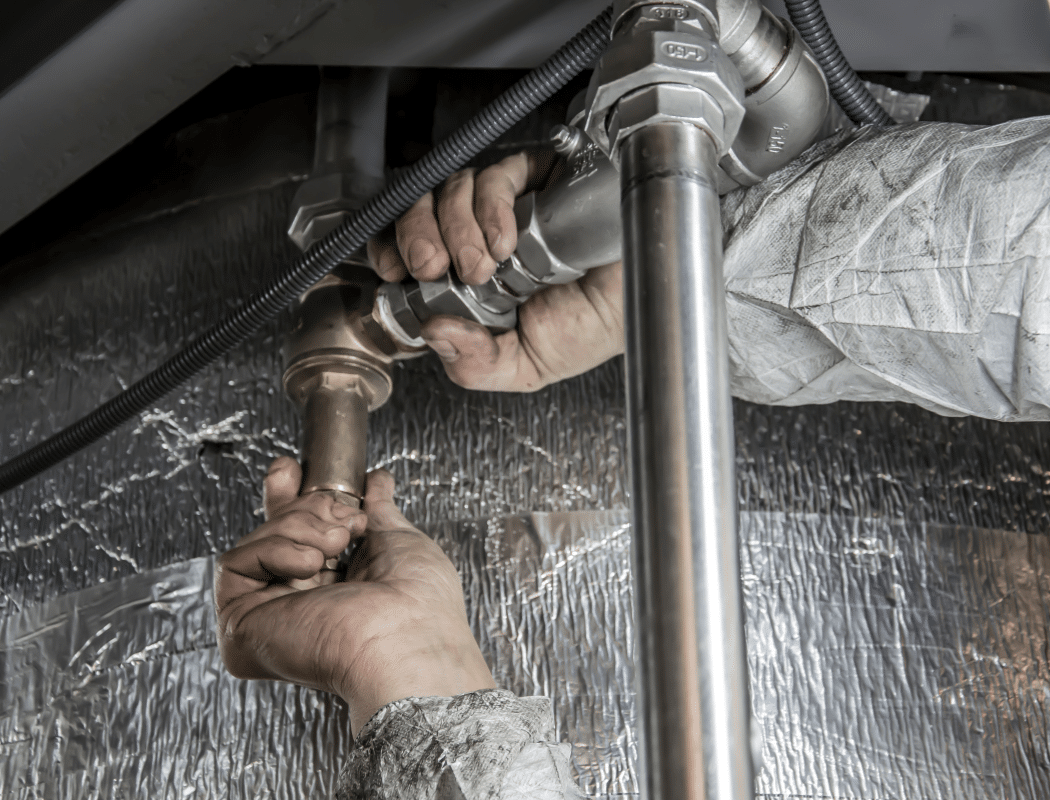
Microbore has one redeeming feature for a leak detection engineer: the manifolds. Because each radiator has its own feed from a central block, we can isolate and pressure test the system loop by loop and prove exactly which run is losing water before any floor comes up. On a standard two-pipe system that sectioning is much cruder.
Once the guilty run is identified, the pinpointing works like any buried heating leak, with the balance of methods shifted for small pipe. With the system warm, thermal imaging maps the run and shows a leak as a spreading warm plume rather than a tidy line. Where the escape is too small or deep for a clear heat signature, we drain the loop and introduce a hydrogen and nitrogen tracer gas, which escapes at the split and rises through the floor to a probe. On pencil-thin pipe losing a cupful an hour, tracer gas leak detection is frequently the only method with the sensitivity to nail the spot.
The result is one marked point and one small opening, not a lifted hallway. If your gauge is creeping down right now, call us on 07700 152 467 before anyone starts lifting boards on a guess.
For the wider elimination process on any heating circuit, radiators and boiler included, see our guide on how to find a leak in a central heating system.
Repair or re-pipe: the honest answer
When a repair makes sense
- First leak the system has ever had
- Cause is mechanical: a kink, a nail, a rubbed section
- The rest of the system heats well and the water runs clean
- The leak is pinpointed and access is straightforward
When to think about re-piping
- Second or third leak on the same circuit
- Radiators starve repeatedly despite flushing
- Pinholes, meaning the pipe wall itself is failing
- Floors are coming up anyway for other work
A single mechanical failure on an otherwise healthy microbore system deserves a simple repair, followed by a clean and a proper dose of inhibitor. Repeat failures change the arithmetic. Each new pinhole says the pipe wall is thin and the chemistry is active, and every emergency repair costs more than its share of a planned re-pipe done while a room was being refurbished anyway. We put what we find in writing after every survey, and if the honest advice is that the circuit owes you nothing, we will say so.
Frequently asked questions
How do I know if my heating is microbore?
Look at the pipes feeding your radiators. Standard pipe is 15mm, roughly as thick as a thumb, while microbore at 8mm or 10mm looks closer to a pencil. Microbore systems also have manifolds, small distribution blocks under floors or in cupboards where one larger pipe splits into several slim feeds.
Is microbore heating pipe still legal and sold?
Yes. Microbore is still manufactured, sold and installed, and a well-designed modern microbore system works perfectly well. The problems we trace mostly belong to older installations: hand-bent runs, decades of sludge, thin walls reaching the end of their corrosion allowance and manifolds buried without access.
Can a microbore system be power flushed?
With care. The narrow bore that silts up easily also restricts flush flow, and an aggressive power flush can push debris into a blockage or find weak spots the hard way. Many engineers prefer a gentler chemical clean on old microbore. Either way, dose inhibitor afterwards or the sludge simply returns.
Why does my microbore leak not show anywhere?
Because the escape is tiny and buried. An 8mm pipe weeping under a solid floor might lose less than a litre a day, which soaks into screed or timber without ever surfacing. That is why the boiler gauge is usually the only witness, and why detection uses gas and heat rather than eyes.
Does a microbore leak mean the whole system is finished?
Not at all. One mechanical failure, a kink or a rubbed pipe, says nothing about the rest of the system. The time to discuss re-piping is when leaks repeat on the same circuit or pinholes appear, because those point at the pipe wall failing generally rather than one unlucky spot.
Speak to MCR Leak Detection
Topping up the boiler every few days and suspecting those pencil-thin pipes? We pinpoint microbore heating leaks across Scotland with tracer gas and thermal imaging, non-destructively and 24/7, so one board comes up instead of a floor.
Related reading
- How to Find a Leak in a Central Heating System
- Central Heating Pipe Leaking Under the Floor: Signs and What to Do
- Boiler Losing Pressure? Causes and What to Do Next
- Central Heating Inhibitor: Cheap Insurance Against Corrosion Leaks
Or learn more about our water leak detection across Scotland.